
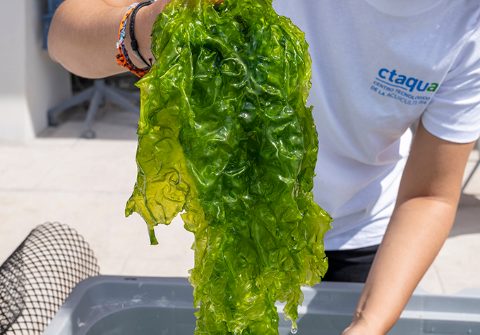
The use of macroalgae as an alternative protein source for aquafeeds is gaining ground as a strategic research area, although technical limitations still constrain its practical application.
One of the main challenges is the low digestibility of some of these proteins, which remain embedded in the algal cell walls and are therefore less available to fish.
In this context, CTAQUA has assessed the potential of fermented and non-fermented Ulva meals as feed ingredients for European sea bass (Dicentrarchus labrax) within the European NOVAFOODIES project, co-funded by Horizon Europe.
The work is part of a broader research line aimed at developing sustainable new ingredients from marine and freshwater raw materials for fisheries and aquaculture value chains.
Fermentation is being explored as a way to improve the nutrient availability of macroalgae. According to the results obtained, the pilot process optimised by the University of Haifa, a partner in the project, increased the protein concentration of Ulva biomass by approximately 20% and significantly reduced its carbohydrate content.
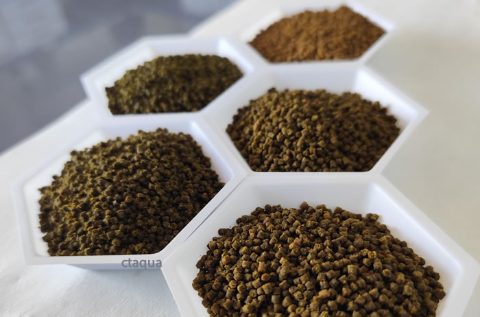
This improvement made it possible to formulate diets with a lower amount of fermented algal meal while achieving an equivalent protein contribution.
Using this biomass, CTAQUA produced experimental feeds with two inclusion levels of non-fermented Ulva, at 5% and 10%, and two equivalent levels of fermented Ulva, at 4.1% and 8.2%.
Their performance was compared with that of a commercial reference feed in a 56-day nutritional trial with juvenile European sea bass in RAS systems.
The results showed that the diets with lower inclusion levels, both fermented and non-fermented, did not produce significant differences in growth compared with the control feed.
By contrast, the diets with higher inclusion levels reduced fish growth, although feed conversion efficiency showed no differences between treatments.
This finding is relevant from a formulation perspective. According to the researchers, the reduced growth observed in the higher-inclusion diets may be more closely related to lower feed intake than to poorer feed utilisation.
This places palatability and diet acceptance among the key factors for further progress in the use of fermented macroalgae in aquafeeds.
The study also assessed the potential bacteriostatic functionality of both the ingredients and the feeds. Ulva extracts, particularly those obtained from fermented biomass, inhibited the growth of five fish-pathogenic bacteria.
However, when the analysis was repeated with the experimental feeds, this activity was only observed in the diets with the highest inclusion level of fermented Ulva.
This suggests that part of the functionality observed in the ingredient may be reduced once incorporated into the feed, either due to dilution within the formulation or to the conditions of the extrusion process used during feed manufacture.
In addition, no bacteriostatic activity was detected in the mucus or blood of fish fed these diets.
The researchers also analysed parameters related to immune response, resistance to pathogens and stress response, but found no significant differences between the treatments evaluated.
Other partners in the NOVAFOODIES consortium also contributed to the work, including ANFACO and the University of Genoa.
Overall, the results indicate that Ulva meal, whether fermented or non-fermented, can be incorporated at moderate levels in sea bass feeds without compromising productive performance. However, higher inclusion levels require caution, particularly because of their possible effect on feed intake and growth.
The team’s next research lines will focus on optimising the use of fermented Ulva by incorporating attractants to improve feed acceptance, as well as carrying out longer trials to determine whether fish can progressively adapt to these diets.
The work will be presented at Aquaculture Europe 2026 in Slovenia and provides useful evidence to guide the development of alternative ingredients based on macroalgae from a scientific, formulation and production-oriented perspective.

Related

Latest In-depth
-
Clams more resistant to heat and Perkinsus: research paves the way for selective breeding
Padua, Italy, 16/10/2026 | University of Padua researchers explain to misPeces the findings presented at Aquaculture Europe 2026 and the steps needed to transfer them to hatcheries. Initial applications could emerge within the next two or three years, although the relationship between resistance, growth and other production traits still need to be assessed