
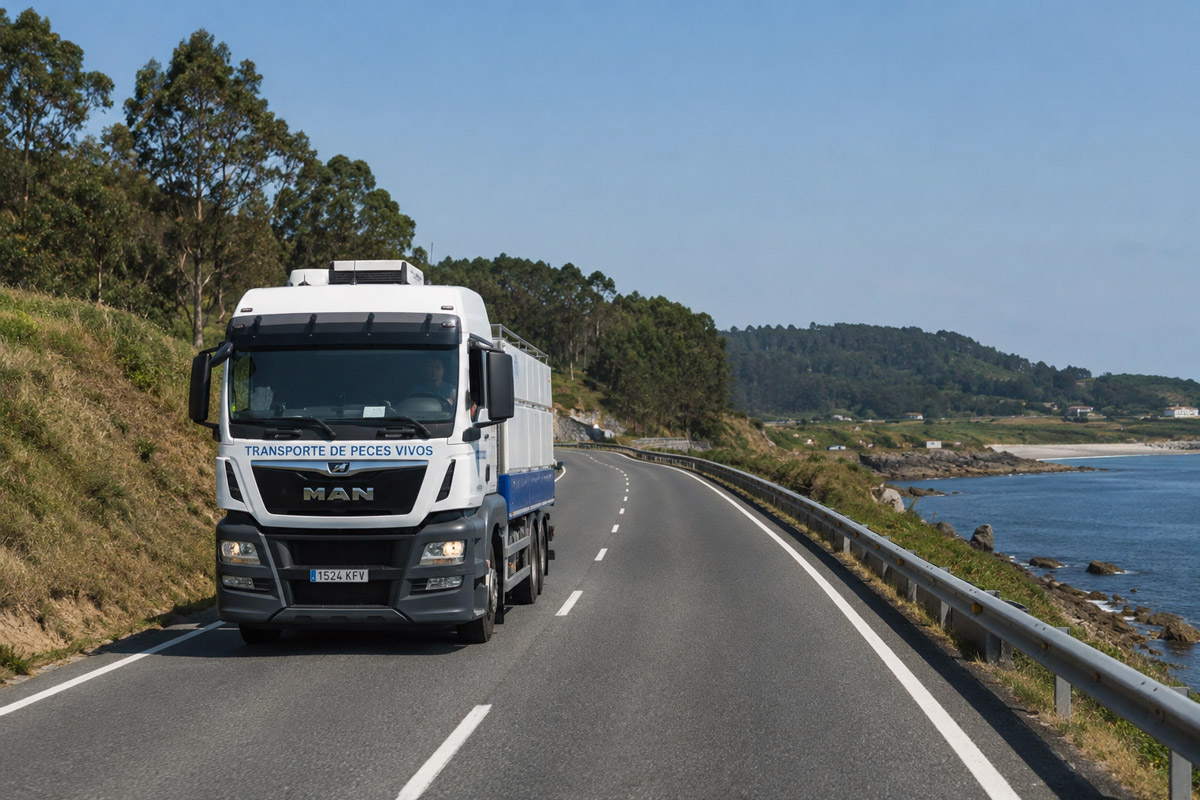
Transporting live fish is a routine operation in aquaculture, from moving juveniles to grow-out facilities to delivering market-sized fish. However, a review published in Reviews in Aquaculture warns that its effects are not determined by any single factor and that conditions must be adapted to the species, fish size, stocking density, journey duration and transport system.
During transport, oxygen consumption and fish excretion progressively alter water conditions. Dissolved oxygen may fall as CO2 and ammonia accumulate and pH changes. High temperatures can aggravate the problem by increasing metabolism and oxygen demand while raising the proportion of ammonia present in its toxic form.
Excessive stocking density further accelerates water deterioration and can increase contact and injures between fish.
These conditions trigger stress responses affecting metabolism, oxidative balance and immune function. When their intensity or duration exceeds the fishes’ ability to adapt, the consequences can include tissue damage, reduced disease resistance, mortality and slower recovery after unloading. In market-sized fish, transport stress may also affect texture, composition and other quality attributes.
The most widely applicable measure is control oxygen, temperature and metabolite accumulation, particularly during long journeys or high-density transport. Pre-transport fasting can reduce excretion and biological oxygen demand, although its duration must be adapted to each situation.
Planning should also cover capture, grading, loading, unloading and recovery because these operations can add to the stress experienced during the journey.
| Stage or risk | What may happen | Priority measure | Main caution |
|---|---|---|---|
| Before transport | Recent feeding and handling increase metabolism and excretion. | Adapt fasting to the species, fish size and journey. | Excessive fasting may affect fish condition. |
| High temperature | Metabolism, oxygen consumption and ammonia-related risk increase. | Stabilise and control temperature. | Avoid sudden temperature changes. |
| Insufficient oxygen | Hypoxia and metabolic and oxidative disturbances may occur. | Oxygenation and dissolved oxygen monitoring. | Adding oxygen does not remove CO2 or ammonia. |
| High stocking density | Water quality deteriorates faster, while contact and injuries may increase. | Adjust biomass, water volume and journey duration. | No single density is suitable for every species. |
| Long transport duration | CO2, ammonia and other metabolic wastes accumulate. | Strengthen environmental control and adjust the load. | Different stressors interact. |
| Salt or water conditioners | They may improve osmotic balance or certain physiological responses. | Use treatments validated for the species. | Results are not consistent across all fish. |
| Anaesthesia or sedation | Activity and responses to external stimuli may be reduced. | Select the substance and dose according to the species and destination. | Consider authorisation, residues, withdrawal periods and recovery. |
| Waterless transport | It reduces transported weight and maintains a depressed metabolic state. | Use only for validated species and journeys. | Strongly dependent on temperature, oxygen and duration. |
| Unloading and recovery | Stress may continue after the journey. | Gradual acclimatisation and monitoring. | Avoid sudden changes in temperature and water quality. |
On smaller screens, scroll horizontally to view all columns.
The review examines evidence from species including European seabass, greater amberjack, turbot, rainbow trout, tilapia, carp, sturgeon, catfish and tambaqui. Some studies evaluate pre-transport nutritional supplementation, while others assess salt or water conditioners, anaesthetics or waterless transport based on the controlled reduction of fish metabolism.
Their findings cannot be compared directly because species, fish size, transport duration and experimental conditions vary.
Reducing transport stress therefore requires more than applying an isolated additive; it requires a protocol designed for each operation. The priority should be to prevent water deterioration and avoid critical combinations of temperature, hypoxia, stocking density and journey duration.
The review also acknowledges that several proposed measures still face limitations in technical maturity, cost or regulation, meaning commercial adoption requires validation under real operating conditions and species-specific criteria.

Related
Latest In-depth
-
Clams more resistant to heat and Perkinsus: research paves the way for selective breeding
Padua, Italy, 16/10/2026 | University of Padua researchers explain to misPeces the findings presented at Aquaculture Europe 2026 and the steps needed to transfer them to hatcheries. Initial applications could emerge within the next two or three years, although the relationship between resistance, growth and other production traits still need to be assessed