
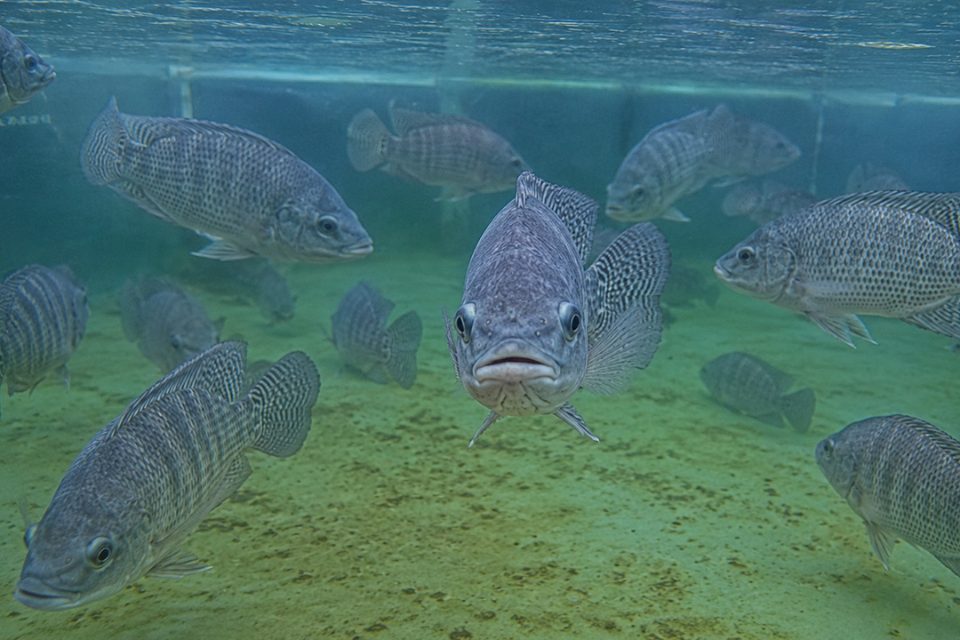
Gene editing —a technique that enables targeted and precise changes to an organism’s DNA, without necessarily introducing genes from other species— has already been used experimentally in more than 40 aquaculture species to modify growth, sex, body colour, disease resistance and product quality.
The next step points fish that are less sensitive to stress, less aggressive and better adapted to adverse environmental conditions, although reliance on microinjection, low editing efficiency in many marine species and the absence of clear regulatory pathways continue to restrict commercial application.
The most advanced work remains focused on traits with a direct and measurable production value. Researchers have edited growth-regulating genes in red seabream, Nile tilapia, carp, catfish and pufferfish, while other studies have targeted feed conversion or the production of all-male and all-female populations in species where one sex grows faster.
The studies reviewed by misPeces include a pufferfish carrying a mutation in the leptin receptor that reached around 1.9 times the body weight of conventional fish, as well as gene-edited catfish capable of reaching market size up to 30% sooner. These results were obtained in specific experimental lines and cannot automatically be extrapolated to other species or farming systems.
The emerging objective is to use genetics to address problems that are difficult to solve through feed, vaccines or farm management alone. Temperature fluctuations, hypoxia, ammonia accumulation, changes in pH, high stocking density and disease can activate prolonged stress responses that reduce growth, immunity and reproductive performance.
Researchers are therefore exploring genes involved in neuroendocrine signalling, stress perception and environmental tolerance. Similar approaches could be used to reduce aggression and cannibalism, particularly in species where territorial behaviour causes injuries, uneven growth and losses under intensive production.
These applications remain largely prospective and require evidence that reduced stress or aggression does not impair essential behaviour or physiological functions.
Gene editing is also moving towards traits that could increase the value and convenience of the final product. Experimental work has produced fish with fewer or no intermuscular bones and has modified pathways involved in the formation of long-chain omega-3 fatty acids.
Colour has already become an important target in tilapia, carp, salmon and ornamental species. Other proposed applications, including fish with less pronounced off-flavours or without hard fin spines that complicate handling, are at a much earlier stage.
The main barrier is no longer the lack of potential traits, but the difficult of producing stable, healthy and economically useful lines. Microinjection into fertilised eggs remains labour-intensive and is especially challenging in marine fish with small or fragile embryos. Long generation intervals also delay the establishment and validation of heritable lines.
Base editing, prime editing, high-fidelity CRISPR variants and delivery through nanoparticles or virus-like particles could improve precision and reduce dependence on microinjection, while artificial intelligence may help predict editing outcomes. Most of the platforms, however, still need to demonstrate reliable performance at hatchery and breeding-programme scale.
Regulation remains an additional dividing line between scientific progress and commercial use in Europe. The EU adopted a new framework in 2026 for plants produced through certain new genomic techniques, but that legislation applies exclusively to plants and their derived food and feed products; it does not create a simplified route of gene-edited fish.
Aquatic animals therefore remain covered by the existing EU framework for genetically modified organisms, which requires prior assessment of food and feed safety, animal health and welfare, and environmental risks before authorisation and marketing.
For European aquaculture, the transition from promising experimental fish to commercial broodstock will consequently depend as much on regulatory clarity, traceability and public confidence as on growth rates or editing efficiency.

Related

Latest In-depth
-
Clams more resistant to heat and Perkinsus: research paves the way for selective breeding
Padua, Italy, 16/10/2026 | University of Padua researchers explain to misPeces the findings presented at Aquaculture Europe 2026 and the steps needed to transfer them to hatcheries. Initial applications could emerge within the next two or three years, although the relationship between resistance, growth and other production traits still need to be assessed