
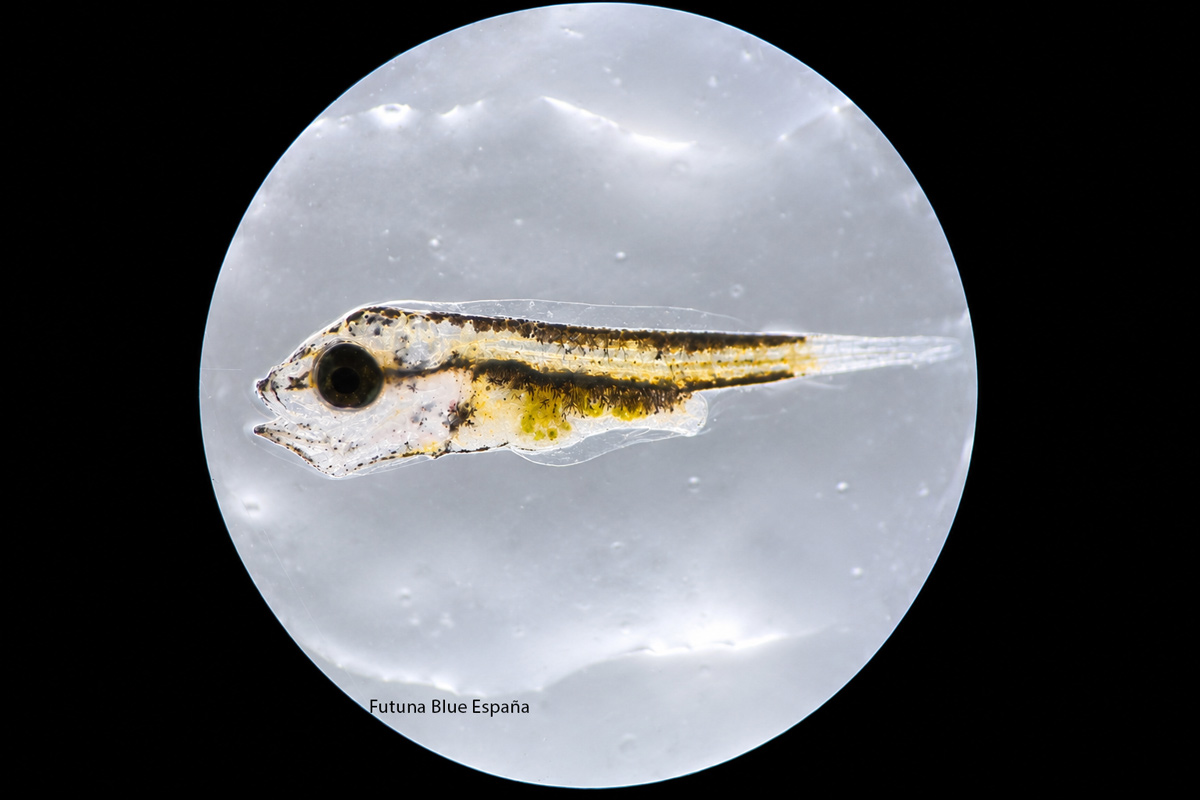
 greater amberjack (Seriola dumerili) larvae | Futuna Blue España
The gut bacterial community of greater amberjack (Seriola dumerili) develops a broader enzymatic repertoire during the larval stage. A study published in Frontiers in Physiology analysed digestive activity in the larvae and their intestinal bacteria at five stages, from 10 to 60 days post-hatching.
The work was carried out at Futuna Blue España’s facilities in El Puerto de Santa María, Cádiz, using larvae from a single spawning. The researchers compared stages associated with the main feeding transitions: from rotifers and Artemia to co-feeding with microdiets and, finally, weaning onto formulated feed.
Bacterial activity varied according to both the enzyme and the larval stage. During co-feeding, at 32 days post-hatching, activity measured in the bacterial fraction was 2.19 times that of the intestinal fraction for chymotrypsin and 4.58 times for chitinase. Bacterial amylase activity was detected only after weaning, at 60 days, when it reached 35.2% of the activity measured in the intestinal fraction.
The authors caution that these percentages compare enzyme activities measured separately under laboratory conditions. Values above 100% do not mean that bacteria digested more feed than the larvae or increased digestion in vivo. Nor does the study show that bacterial activity improves growth or survival.
The composition of the microbiota also changed during development and the transition to formulated feed. Firmicutes increased after co-feeding, accounting for 56% of the bacterial community after weaning. The authors suggest that microbiota activity may complement the larvae’s digestive capacity, a hypothesis that requires further testing.
Reference: Navarro-Guillén C, Pérez-Hilario D, Yufera M and Perera E (2026). “Functional contribution of the gut microbiota to digestive capacity during ontogeny in greater amberjack (Seriola dumerili) larvae”. Frontiers in Physiology, 17:1955641. DOI: 10.3389/fphys.2026.1955641

Related

Latest In-depth
-
Clams more resistant to heat and Perkinsus: research paves the way for selective breeding
Padua, Italy, 16/10/2026 | University of Padua researchers explain to misPeces the findings presented at Aquaculture Europe 2026 and the steps needed to transfer them to hatcheries. Initial applications could emerge within the next two or three years, although the relationship between resistance, growth and other production traits still need to be assessed