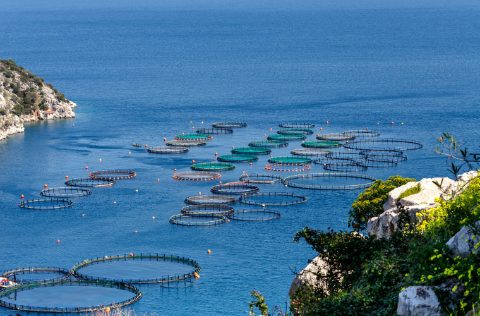
The Mediterranean region, renowned for its rich history and biodiversity, has undergone a significant transformation in the exploitation of its aquatic resources. What was once dominated by fishing is now witnessing a surge in aquaculture, a sector that has expanded rapidly since the mid-20th century.
A recent study by Benedetto Sicuro from the University of Turin, Italy, published in PLOS ONE, examines this phenomenon and suggests that Mediterranean aquaculture has reached an "anthropogenic climax stage". At this point, a few species dominate production, although there are also substantial opportunities for diversifying and expanding the sector.
Since 1950, Mediterranean aquaculture has passed through several phases, driven by the introduction of new species and technologies. Nile tilapia has emerged as the most dominant species, particularly in Egypt, which leads the region's production. It is projected that by 2030, Egypt will reach a production level of over 2 million tonnes.
On the other hand, the growth of marine species such as European seabass and gilthead seabream in Greece and Turkey demonstrates how technological innovation has propelled the expansion of aquaculture in the eastern Mediterranean. This growth led Mediterranean aquaculture production to reach 2.8 million tonnes in 2020, with projections to increase to 3.65 million tonnes by 2030.
The study covers the evolution of aquaculture in key countries such as Egypt, Greece, Italy, Spain, Turkey, Israel, and Malta. Egypt stands out as the leading producer, dominated by Nile tilapia. As for Italy and Spain, although they have historically been significant players, particularly in trout and mussel farming, their growth has been more moderate, losing prominence compared to other countries.
Greece and Turkey are recognised for their role in the expansion of marine aquaculture, establishing themselves as leaders in the production of seabass and seabream, thanks to the adoption of advanced technologies.
Despite the growth, the study warns about the reliance on a few species, which could limit the sector's long-term sustainability. To mitigate this risk, it is suggested that the region should focus on diversifying the species being farmed, which would not only enhance food security but also open up new markets.
The study also draws a parallel between the evolution of aquaculture and natural ecological processes, suggesting that aquaculture has reached a point of equilibrium or "climax", similar to what occurs in natural ecosystems. However, this climax does not signify an end but rather a solid foundation upon which to build a more diverse and sustainable future. Technology will continue to play a crucial role, but equally important will be the socio-economic policies and cultural traditions that have shaped Mediterranean aquaculture.
Egypt is expected to continue leading the sector, but other Mediterranean countries have the opportunity to emerge as aquaculture powerhouses if they adopt sustainable and diversified models. Malta, though an exceptional case in terms of relative productivity, demonstrates how technology and state support can transform a sector.
Reference:
Sicuro, B. (2024). The evolution of aquaculture in the Mediterranean region: An anthropogenic climax stage? PLOS ONE, 19(8), e0290870

Related

Latest In-depth
-
Clams more resistant to heat and Perkinsus: research paves the way for selective breeding
Padua, Italy, 16/10/2026 | University of Padua researchers explain to misPeces the findings presented at Aquaculture Europe 2026 and the steps needed to transfer them to hatcheries. Initial applications could emerge within the next two or three years, although the relationship between resistance, growth and other production traits still need to be assessed