
Protecting kelp during its earliest life stages may not always prepare it adequately for the conditions it will encounter at sea. A review published in Reviews in Aquaculture suggests that exposing gametophytes and young sporophytes to controlled, non-lethal stress could help preserve the growth and resilience of cultivated Saccharina japonica. The proposal addresses germplasm degeneration, reflected in declining productivity, disease resistance and tolerance to environmental stress.
The problem is particularly relevant in China, where kelp production is based on genetic material originally introduced from Japan and subsequently improved through selection and hybridisation. In 2023, the country produced 1.779 million tonnes in dry weight across 50,795 hectares.
According to the authors, intensive cultivation within a relatively narrow genetic background, intermixing between varieties and the use of small parental populations may progressively reduce adaptive variation.
Genetics may not be the only factor
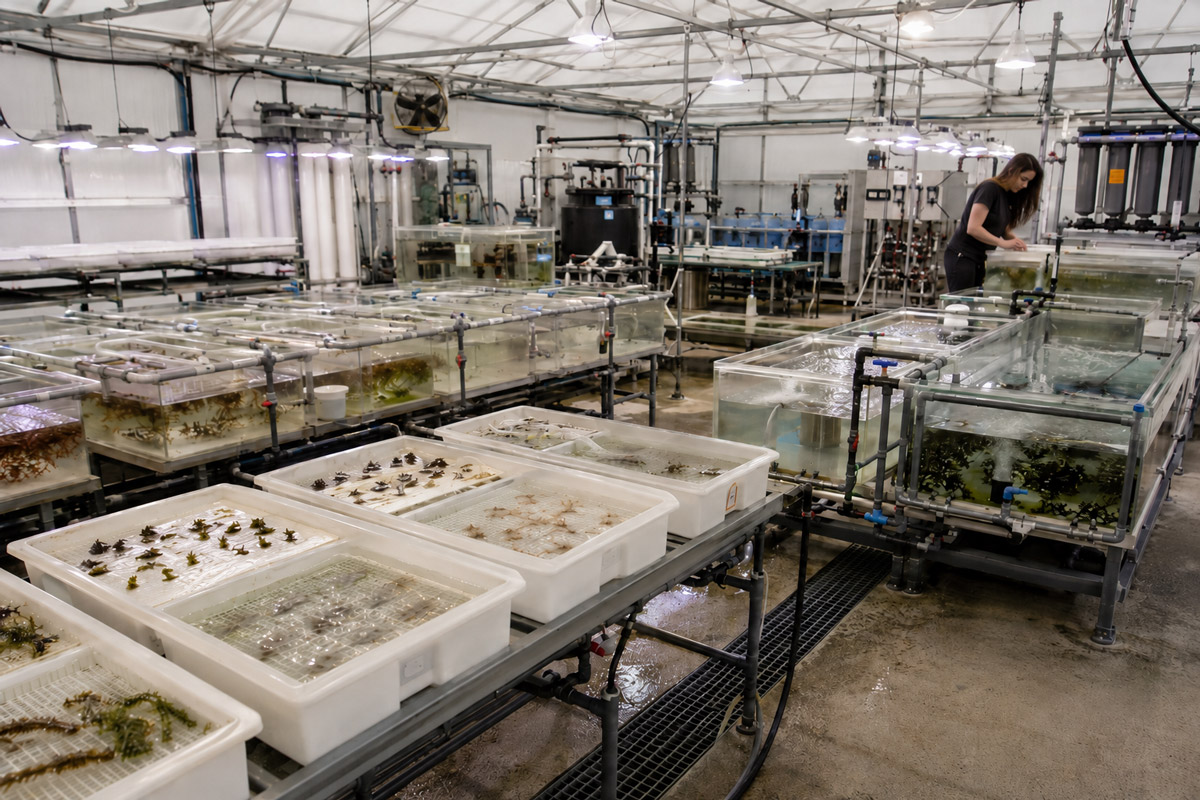
Current nursery systems raise seedlings during summer in precooled, filtered and UV-disinfected seawater, protecting gametophytes, gametes and young sporophytes from many of the pressures found in the natural environment.
Although these conditions support survival and simplify seed production, the review argues that they may also reduce biological competition and deprive the kelp of previous exposure to temperature fluctuations, salinity changes, nutrient shortages or strong irradiance.
The researchers therefore propose a “screening plus training” strategy. Screening would involve more intensive selection of parental sporophytes and seedlings, extending evaluation beyond visible characteristics such as blade length, width, colour and thickness to include physiological, molecular and quality indicators.
Training would expose parental gametophytes or young sporophytes to moderate levels of heat, low salinity, nutrient limitation, high irradiance or darkness before their transfer to the sea.
This conditioning is based on the ability of an organism to respond more effectively to a pressure after previously experiencing a milder version of it.
Earlier studies in plants, seagrasses, microalgae and macroalgae indicate that priming can modify physiological and epigenetic responses. Research cited in the review also suggests that the thermal history of kelp gametophytes can influence sporophyte formation, survival and temperature tolerance.
The strategy does not replace conventional selection, hybridisation or the introduction of new genetic variation. Nor does the review demonstrate that conditioned kelp already produces higher yields on commercial farms.
Stress intensity, exposure time, recovery periods, persistence of the response and production costs still need to be established for each strain and farming environment.
Nevertheless, integrating controlled conditioning into nursery protocols could offer kelp producers an additional route to obtain more resilient seed while longer-term breeding programmes continue.

Related

Latest In-depth
-
Clams more resistant to heat and Perkinsus: research paves the way for selective breeding
Padua, Italy, 16/10/2026 | University of Padua researchers explain to misPeces the findings presented at Aquaculture Europe 2026 and the steps needed to transfer them to hatcheries. Initial applications could emerge within the next two or three years, although the relationship between resistance, growth and other production traits still need to be assessed