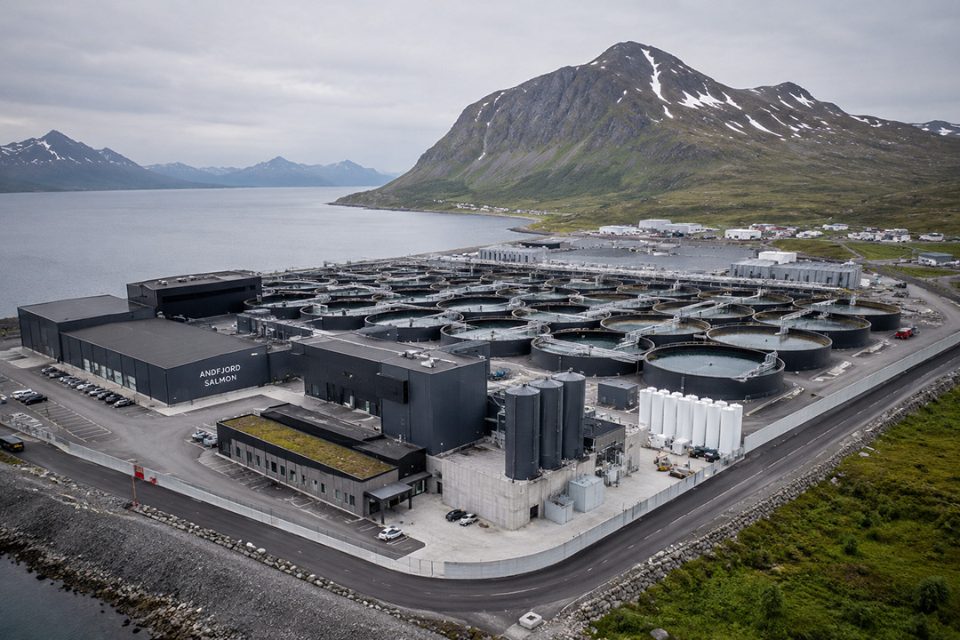
Land-based Atlantic salmon farming continues to attract investment and generate growth expectations, but it has yet to reach the level of industrial development achieved by conventional sea-base production.
This is the view of Mowi, the world’s largest salmon producer, which in its Salmon Farming Industry Handbook 2026 describes salmon production in recirculating aquaculture system (RAS) as a technology with significant potential, but one that still carries a relatively high level of risk.
According to the Norwegian company, marine salmon farming currently represents one of the most industrialised aquaculture production systems in the world.
Decades of experience, genetic improvement, advances in nutrition, economies of scale and a fully developed supply chain have enabled the industry to produce millions of tonnes of fish in a competitive and predictable manner.
Against this backdrop, Mowi considers land-based systems to remain at an early stage of industrial development. Although RAS technology has advanced considerably and new projects are coming into operation, production volumes remain limited compared with conventional marine farming, while operational and economic challenges persist.
The company’s position carries particular weight given its scale within the sector. In 2025, Mowi harvested nearly 559,000 tonnes of Atlantic salmon, giving it a unique perspective on the factors that determine the competitiveness of different production models.
From this standpoint, the assessment of new technologies is based not only on technical feasibility, but also on their ability to operate reliably, profitably and at industrial scale.
The handbook argues that the main challenge for land-based salmon farming is no longer proving that fish can be successfully reared in closed recirculating systems. Instead, the challenge is achieving productivity levels and production costs capable of competing with a highly optimised marine industry.
Profitability, energy consumption, biological performance and the ability to scale production remain critical factors in determining the long-term success of these projects.
Despite its reservations, Mowi acknowledges that technological development could support significant growth in land-based salmon production over the coming years, particularly in regions located close to consumer markets or where access to new marine farming licences is restricted.
For now, however, the company maintains a cautious outlook and continues to view marine farming as the benchmark model for industrial-scale Atlantic salmon production.

Related

Latest In-depth
-
Clams more resistant to heat and Perkinsus: research paves the way for selective breeding
Padua, Italy, 16/10/2026 | University of Padua researchers explain to misPeces the findings presented at Aquaculture Europe 2026 and the steps needed to transfer them to hatcheries. Initial applications could emerge within the next two or three years, although the relationship between resistance, growth and other production traits still need to be assessed