
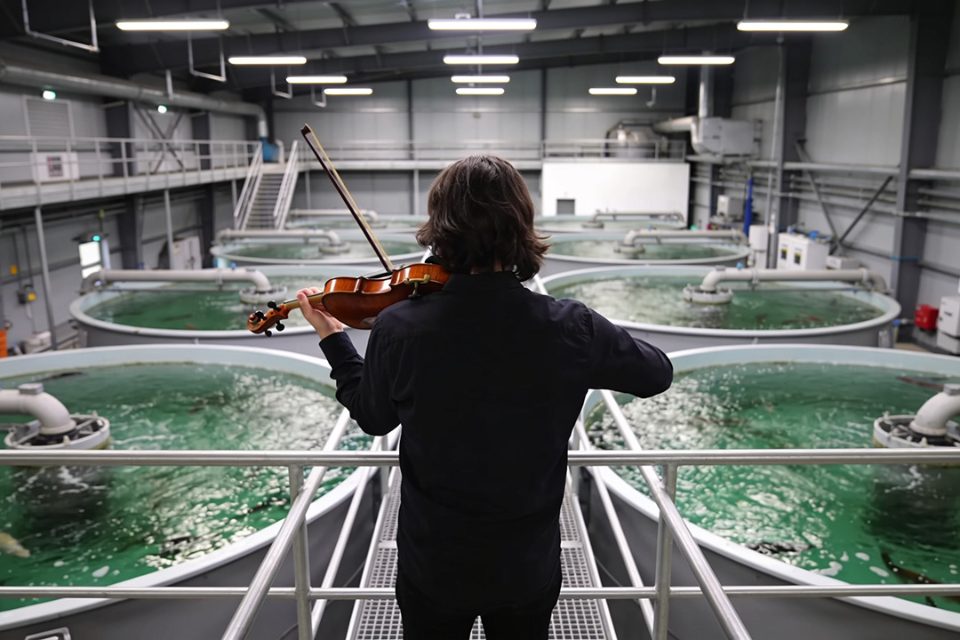
The management of the acoustic environment is beginning to emerge as a new area of research in aquaculture. According to the existing scientific literature, music and other structured sound stimuli can influence the behaviour, physiology, stress response and welfare of different animals, with particular attention now being paid to the still underexplored potential in fish.
The conclusions of these studies should be interpreted with caution. However, the evidence gathered so far suggests that noise is not a neutral element in aquaculture systems, and that fish not only perceive sound, but may also respond to specific acoustic conditions through changes in behaviour, stress response and even some indicators related to growth and feed efficiency.
In water, acoustic signals are transmitted efficiently and can influence orientation, feeding, reproduction, fear responses and social interaction in fish.
Many fish species have well-developed auditory systems adapted to the aquatic environment. In some species, the swim bladder, inner ear, lateral line or other specialised structures allow them to detect vibrations, sound pressure, frequency and sound direction.
For this reason, the relevant question is not simply whether music can “relax” fish, but what type of sound stimuli may be useful, in which species, at what intensity, for how long and under which farming conditions.
This capacity opens the door to studying music as a form of environmental enrichment, while clearly distinguishing it from anthropogenic noise, which can have negative effects when it exceeds certain thresholds or is applied inappropriately.
In fish, the available evidence remains limited, but it includes results of interest for aquaculture.
Some studies have observed that musical stimuli, particularly classical music, can moderately improve growth and feed conversion parameters in species such as common carp, gilthead seabream and rainbow trout under experimental conditions.
Effects have also been described on stress response, cortisol levels, locomotor activity and anxiety-related behaviours in model species such as zebrafish.
In gilthead seabream, some studies have evaluated exposure to pieces by Mozart, Bach and other musical stimuli in recirculating systems, observing changes in growth, body weight, feed conversion and brain neurotransmitters.
In rainbow trout, other trials have compared musical stimuli with white noise and control groups, reporting differences in growth efficiency.
In zebrafish, music and auditory enrichment have been used to study anxiety, endocrine response and behaviour after stress or isolation conditions.
These results do not mean that music can already be incorporated as a standard management tool in commercial fish farms.
For this type of application to reach commercial scale in the form of useful protocols, many questions remain unresolved for each species regarding the farming environment, sound intensity, frequency, rhythm, exposure time and the physiological status of the animals.
What the studies do show is that sound within aquaculture facilities should be taken into account when designing production environments, both for its potential practical value and for the adverse effects that noise may generate.
In a context in which animal welfare is becoming an increasingly important criterion for regulation, certification and the social acceptance of aquaculture, bioacoustics is emerging as a field with potential.
Its main advantage is that it could offer non-invasive and low-cost tools to modulate the farming environment. Its main limitation, for now, is that the evidence is still not strong enough to turn it into a general recommendation.

Related

Latest In-depth
-
Clams more resistant to heat and Perkinsus: research paves the way for selective breeding
Padua, Italy, 16/10/2026 | University of Padua researchers explain to misPeces the findings presented at Aquaculture Europe 2026 and the steps needed to transfer them to hatcheries. Initial applications could emerge within the next two or three years, although the relationship between resistance, growth and other production traits still need to be assessed