
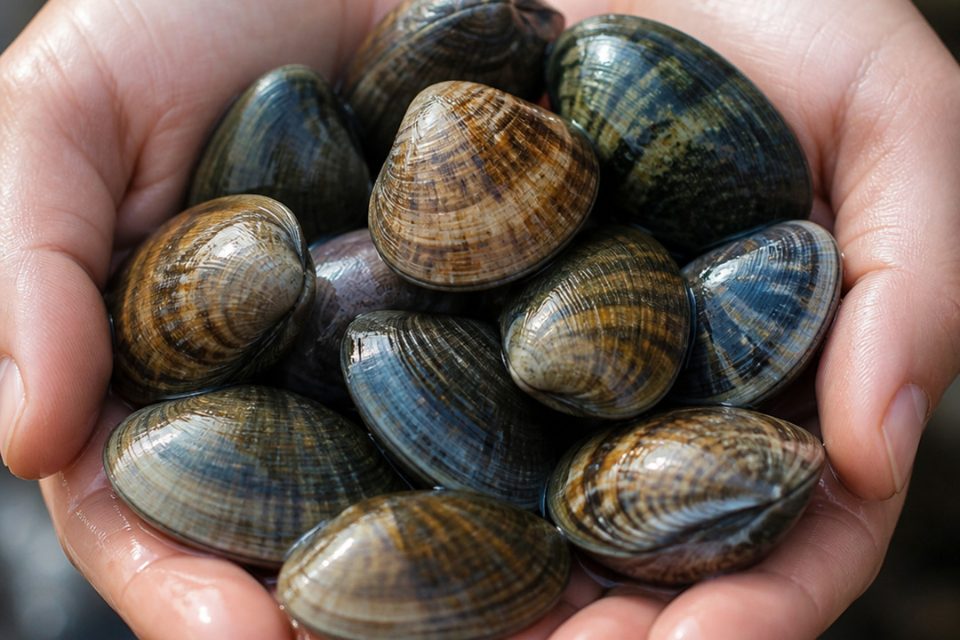
A European consortium has developed a dual-species SNP array for the Manila clam (Ruditapes phillippinarum) and the grooved carpet shell clam (Ruditapes decussatus), a genomic tool that could support progress in breeding, conservation and traceability for two of the most relevant bivalves in aquaculture and shellfish harvesting.
The work, published in Aquaculture, was carried out by the University of Padua (Italy), the University of Santiago de Compostela (Spain), CIIMAR (Portugal), The Roslin Institute at the University of Edinburgh (UK), the Technical University Institute of Brest-Morlaix (France), Benchmark Genetics (Norway) and Thermo Fisher Scientific (USA).
The 63K SNP array includes 49,392 markers for the Manila clam and 14,193 for the grooved carpet shell clam. Its aim is to provide a shared platform for population genetics studies, parentage reconstruction, breeding programmes, genetic diversity monitoring and the management of wild resources.
The importance of the advance lies not only in the technology itself, but in the gap it addresses. Unlike more industrialised aquaculture species, European clam production remains strongly dependent on the availability of natural seed, pressure on wild populations, translocations and the difficulty of accurately controlling the genetic origin of stocks.
In this context, a standardised genotyping platform could enable a shift in scale: from management based mainly on the resource available to a more traceable, comparable and long-term approach to genetic management.
The Manila clam, native to the Indo-Pacific and introduced into Europe in the 1970s, has expanded due to its fast growth and greater environmental tolerance.
The grooved carpet shell clam, native to Mediterranean and Atlantic areas of Europe, retains high commercial value, but its populations have suffered significant declines in recent decades.
What the new SNP chip provides
To develop the array, the researchers used genomic resources from wild and hatchery populations across several European countries.
The design combined a new chromosome-level reference genome for the Manila clam with previous genomic data and new sequencing data for the grooved carpet shell clam.
Subsequent validation showed strong genotyping performance, with informative markers, low levels of missing data and sufficient genome-wide coverage for population genetics and breeding applications.
The panel offers higher resolution in the Manila clam, which could make it particularly useful for high-resolution analyses such as genome-wide association studies or genomic prediction, provided that suitable reference populations are developed.
In the grooved carpet shell clam, the lower marker density makes the panel more suited to population structure studies, genetic diversity analysis and medium-resolution applications.
One of the most relevant results from an applied perspective is the chip’s ability to reconstruct parentage in the Manila clam.
In hatchery systems and breeding programmes, this function is key to controlling inbreeding, organising families, maintaining traceable lines and designing more effective selection schemes.
From advanced aquaculture genomics to molluscs
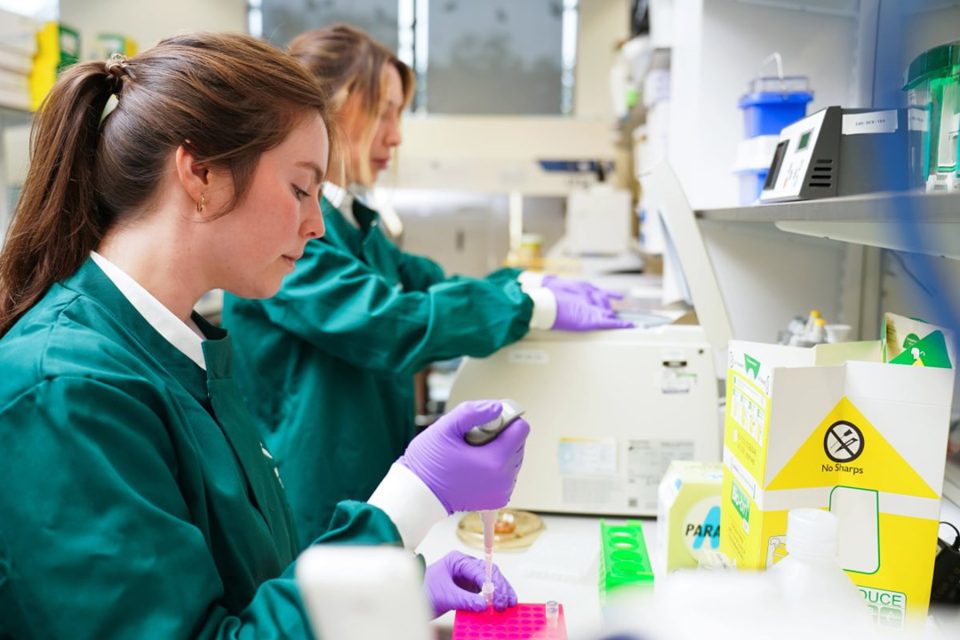 Genotyping laboratory | Benchmark Genetics
Benchmark Genetics’ participation adds an industrial dimension to the work. The company was involved in the design, bioinformatic analysis and validation of the array, reinforcing the idea that genomic tools commonly used in more technologically advanced species are beginning to move into commercially relevant molluscs.
Carolina Peñaloza, Head of Genotyping at Benchmark Genetics, highlights that this resource opens up new opportunities to accelerate genetic improvement and support the conservation of valuable populations.
In molluscs, where genetic variability is high, genotyping can be technically challenging and management has historically depended heavily on natural populations, access to standardised platforms may be particularly important.
An enabling tool, not an immediate solution
The chip does not deliver immediate production gains, but it provides a foundation for selection, traceability and conservation programmes.
It can be applied in hatcheries, production areas and public genetic management programmes, and could also help identify more resilient stocks in the face of climate change if further studies are developed.
Its real value will depend on adoption by the sector and on its ability to address specific challenges: selecting more productive or resistant families, controlling inbreeding, differentiating populations and improving seed traceability.
Rather than a final solution, the SNP array is an enabling tool. Its impact will depend on whether genetic information can be translated into practical decisions for management, selection and conservation.
Scientific reference
Gallo, M., Babbucci, M., Fernández Boo, S., Bean, T., Dalla Rovere, G., Smits, M., Peñaloza, C., Houston, R., Woolley, S., Cicala, F., Franch, R., Ferraresso, S., Nai, I., Patarnello, T., Omole, A. E., Blanco, A., Sambade, I., Martínez, P., Bargelloni, L., Milan, M. & Peruzza, L. (2026). A dual-clam species 63K SNP array for sustainable production and conservation of wild resources. Aquaculture, 625, 744323. https://doi.org/10.1016/j.aquaculture.2026.744323
Related

Latest news
-
Financial model projects a 19.4% internal rate of return for an offshore European seabass farm off France
France, 23 October 2026 | The hypothetical operation would require nearly $40 million investment and produce 5,220 tonnes a year at full capacity. The projected return depends on assumptions that have yet to be tested at commercial scale
-
FEAP calls for binding fish farming production targets in EU's Vision 2040
Brussels, 22/10/2026 | European fish farmers welcome the Commission's plans to simplify aquaculture licensing but call for measurable growth targets, national commitments and a regulatory framework that supports investment
-
A rapid test for tilapia lake virus moves closer to on-farm diagnosis
Thailand, 22 October 2026 | A lateral flow test correctly identifies 60 out of 61 tilapia samples, offering a potential tool for preliminary virus detection, although further validation is needed to establish its ability to identify early-stage infections