
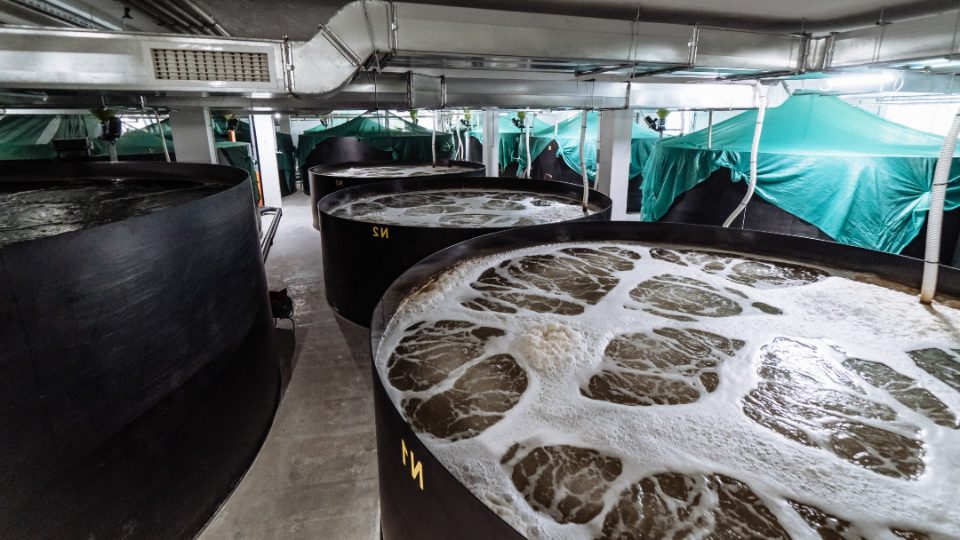
In the farming of Pacific white shrimp (Penaeus vannamei), Artemia has been an essential live feed due to its high availability and nutritional value, especially during the early stages of development. However, feeding with Artemia presents challenges in terms of both quality fluctuation and costs, as its production is restricted to a few reliable sources worldwide, prompting the search for viable alternatives.
Among the new solutions, a team of researchers from the Federal University of Santa Catarina (UFSC) proposes the use of nematodes such as Panagrolaimus sp., tiny worms that have demonstrated high survival rates in shrimp post-larvae under biofloc conditions.
The study was conducted at the university’s facilities, and the experimental design involved a completely randomized approach with four treatment groups and quadruplicate replicates.
Although the shrimp post-larvae fed with inert feeds showed superior growth in terms of weight and length, those fed with nematodes or live Artemia had relatively higher survival rates. Additionally, the group fed with Panagrolaimus sp. exhibited higher alkalinity and pH levels in the final days of the experiment, which may have contributed to lower nitrite levels compared to the control groups.
Another indication that these nematodes can serve as a substitute for Artemia was observed in salinity stress tests, as no significant differences were found compared to the control group.
The fact that nematodes can be cultivated in large quantities, both in liquid and solid media using bacteria as a food source, is an added advantage. Additionally, their ability to survive desiccation allows for prolonged storage and quick reactivation through rehydration, facilitating their use in aquaculture when needed.
Furthermore, they are rich in protein and essential omega-3 fatty acids like EPA and DHA, and they can be enriched with additional nutrients to further enhance their nutritional value.
Finally, they have proven to be particularly effective in biofloc systems, a sustainable approach to aquaculture that reduces water usage and improves the environmental quality of the farm.
Reference:
Sommer, N.P.; Martins, M.A.; Rezende, P.C.; Seiffert, W.Q.; Seychelles, L.H.; Aragão, C.; Vieira, F.B. Nematodes Can Substitute Artemia in a Co-Feeding Regime for Pacific White Shrimp Post-Larvae Reared in a Biofloc Nursery System. Animals 2024, 14, 2679.

Related

Latest In-depth
-
Clams more resistant to heat and Perkinsus: research paves the way for selective breeding
Padua, Italy, 16/10/2026 | University of Padua researchers explain to misPeces the findings presented at Aquaculture Europe 2026 and the steps needed to transfer them to hatcheries. Initial applications could emerge within the next two or three years, although the relationship between resistance, growth and other production traits still need to be assessed