
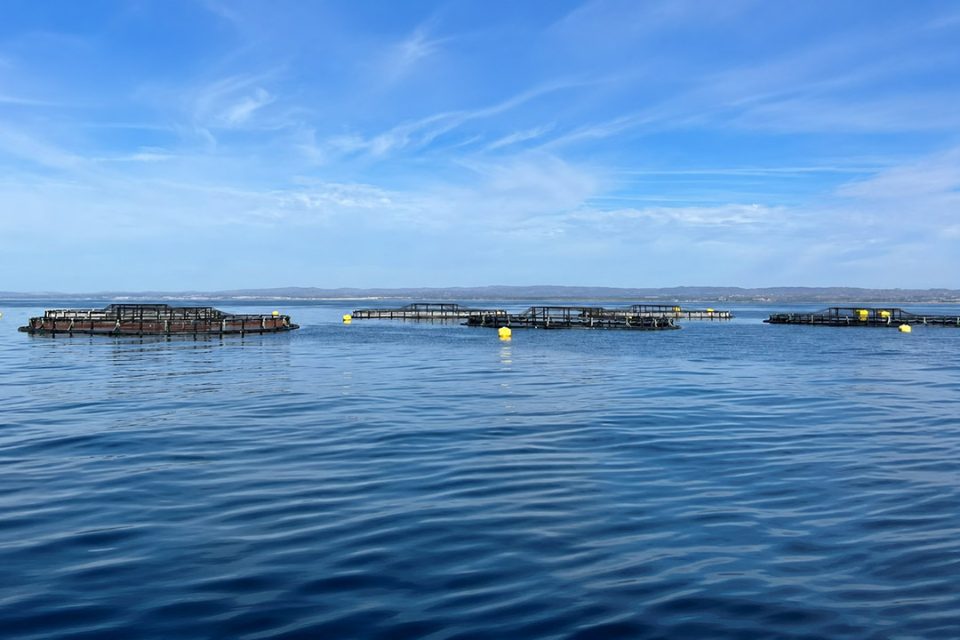
New diets for European seabass and gilthead seabream developed under the Pep4Fish project have entered trials under real aquaculture production conditions in Portugal’s Algarve region.
The formulations contain protein hydrolysates produced from animal by-products that would otherwise be discarded, as well as alternative sources such as insects. The trial marks the transition from laboratory testing to farm-scale validation of diets designed to improve fish robustness and reduce their vulnerability to stress and disease.
The trials run for three months at Seaculture’s offshore facilities. The company, which belongs to Jerónimo Martins Agro-Alimentar and is a partner in the consortium, will conduct an initial assessment of growth, survival and feed utilisation, together with a preliminary comparison against commercial diets.
Although this period does not cover a complete production cycle, it should provide initial evidence of any improvements. It will not, however, confirm long-term effects or increased disease resistance. Important information also remains unavailable, including the hydrolysate inclusion rates, number of fish, experimental controls, quantitative results, costs and commercial viability.
The trial will therefore need to establish whether the improvements observed are meaningful and scalable at industrial level.
The precise formulations form part of the industrial partner’s technical know-how and are subject to the European regulations applicable to animal feed.
According to information provided by the consortium, previous trials conducted at CIIMAR showed improvements in fish survival, together with positive results related to growth.
The phase now under way at Seaculture will determine whether these effects can be reproduced at a large scale and under less controlled environmental conditions.
The project also aims to strengthen resistance to disease and improve the final quality of the product supplied to consumers.
Pep4Fish brings together AgroGrIN Tech, B2E CoLAB, CIIMAR, the School of Biotechnology of the Universidade Católica Portuguesa, ITS, Savinor, Sebol, Sorgal and Seaculture. It forms part of the Blue Economy Pact funded through Portugal’s Recovery and Resilience Plan.

Related

Latest In-depth
-
Clams more resistant to heat and Perkinsus: research paves the way for selective breeding
Padua, Italy, 16/10/2026 | University of Padua researchers explain to misPeces the findings presented at Aquaculture Europe 2026 and the steps needed to transfer them to hatcheries. Initial applications could emerge within the next two or three years, although the relationship between resistance, growth and other production traits still need to be assessed