
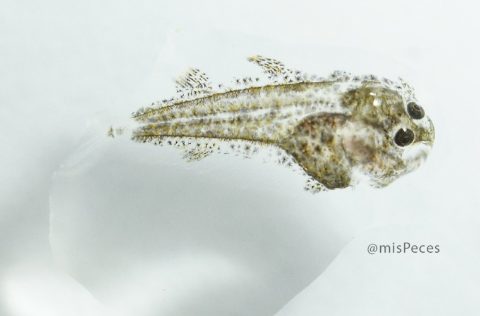
 Sole larvae |misPeces
A team from the Universidade de Santiago de Compostela, with the participation of GENEAQUA, has identified two potential non-invasive functional indicators for monitoring early development in Senegalese sole (Solea senegalensis): locomotor response to light-dark cycles and endogenous autofluorescence detectable without external staining.
The study, published in Aquaculture Reports, analysed larvae between 72 and 192 hours post-fertilisation using a light-dark behavioural assay and fluorescence microscopy. The aim was to characterise how locomotor activity changes during early development and to explore whether natural autofluorescence signals could provide additional information on larval status.
The results describe a developmental trajectory in which detected activity was higher at early stages, with a descriptive peak around 96 hours post-fertilisation, before decreasing towards 192 hours. At the same time, the response to changes in illumination became more organised at later stages, with a clearer tendency towards higher activity in darkness than in light.
The authors emphasise that these findings should not be interpreted as a direct measure of visual or neurosensory maturation, but rather as functional indicators of the relationship between illumination, locomotion and larval development. In this context, the light-dark assay may be particularly informative between 144 and 192 hours post-fertilisation, when the behavioural response becomes more structured.
The study also describes an endogenous autofluorescence signal, detectable without external markers, which was stronger between 96 and 168 hours post-fertilisation and declined markedly by 192 hours. The signal was mainly observed in cephalic and body regions and in association with superficial pigmented structures, although the authors note that additional spectral controls will be required to confirm its origin.
From an applied perspective, these indicators could contribute to the development of non-invasive monitoring tools for Senegalese sole larval rearing, a species of interest for Iberian aquaculture. Their potential value lies in complementing traditional morphological criteria, improving the standardisation of behavioural assays and helping assess the effects of rearing conditions such as light regime, photoperiod and larval quality.
Reference
Arana AJ, Torres-Sabino D, Carballeda M, Aramburu O, Martínez P, Sánchez L. 2026. Non-invasive functional indicators of early development in Solea senegalensis: Ontogeny of the light-dark response and endogenous autofluorescence. Aquaculture Reports, 49, 103673. DOI: 10.1016/j.aqrep.2026.103673.

Related

Latest In-depth
-
Clams more resistant to heat and Perkinsus: research paves the way for selective breeding
Padua, Italy, 16/10/2026 | University of Padua researchers explain to misPeces the findings presented at Aquaculture Europe 2026 and the steps needed to transfer them to hatcheries. Initial applications could emerge within the next two or three years, although the relationship between resistance, growth and other production traits still need to be assessed