
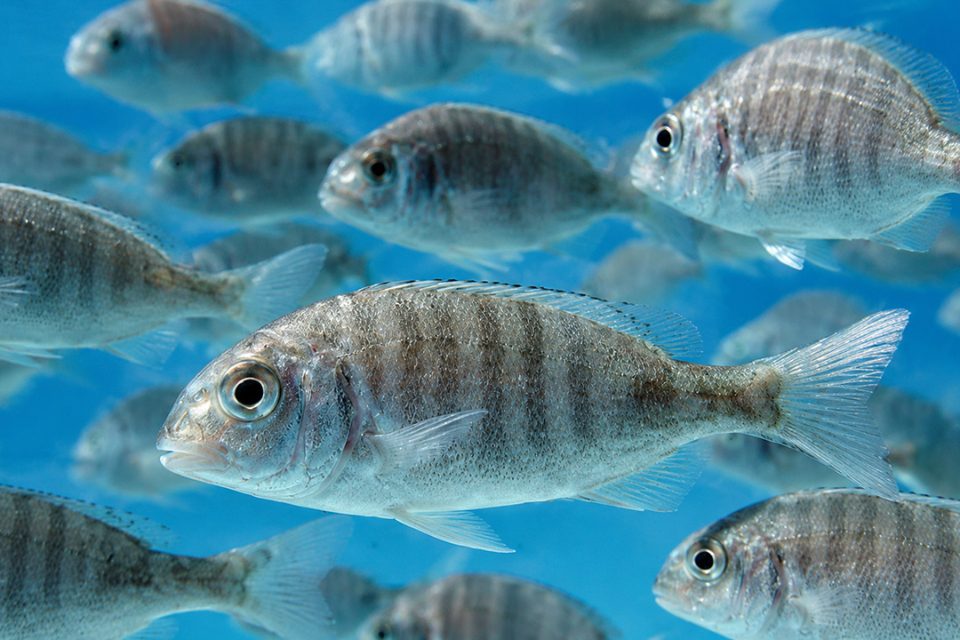
A new ten-month study on gilthead seabream (Sparus aurata), carried out by researchers at the Institute of Aquaculture Torre de la Sal (IATS-CSIC), offers a particularly useful reading for the Mediterranean sector: alternative diets can maintain performance under warmer summers, but their real value becomes clearer when the physiological mechanisms supporting that response are analysed.
The challenge is no longer only to formulate more sustainable aquafeeds, but to understand which biological mechanisms make them work under increasingly variable and demanding farming conditions.
Between May 2022 and February 2023, batches of Mediterranean-origin juvenile gilthead seabream, reared from 10-15 grams in 3,000-litre tanks, were fed a commercial plant-based diet; a diet containing processed animal proteins and salmon oil by-products; and an alternative formulation with insect protein, microbial biomass and algal oil.
The trial coincided with one of the warmest thermal periods recorded in the centre’s time series. According to the authors, temperatures at the IATS facilities have increased by around 0.1 ºC per year over the past decade, with an even more pronounced trend during summer.
In this context, the 2022 cohort showed growth rates 10% to 15% higher and shorter production cycles, especially up to harvest sizes of 300 to 350 grams.
The feed conversion ratio remained around 1.23-1.24, and no relevant histological alterations were observed in the liver or intestine. In other words, the alternative diets worked in productive terms, as no reduction in growth, feed conversion or tissue integrity was detected.
However, the interest of the study lies precisely in what appears beneath this apparent productive equality. Although the fish grew in a similar way, they did not do so through the same physiological strategy.
The alternative diet containing insects, microbial biomass and algal oil was associated with lower basal cortisol levels, a more proactive behavioural response to a confinement test, and greater intestinal transcriptional activity. This suggests a possible improvement in the response to common farm stressors, such as handling, changes in density or environmental pressure.
The diet based on processed animal proteins also sustained growth, but showed a different signal: lower transcriptional activity in the liver and white muscle, which the authors interpret as a possible metabolic trade-off that could affect the capacity for cold adaptation.
This is not an immediate productive problem, but it is an important warning for cycles that pass through highly contrasting seasons.
| Diet evaluated | Key ingredients | Productive result | Physiological response observed | Reading for the farm |
|---|---|---|---|---|
| Control diet | Commercial plant-based formulation, with reduced levels of fishmeal and fish oil | High growth and FCR similar to the other diets | Reference physiological profile | Serves as a benchmark for current alternative diets |
| PAP diet | Processed animal proteins and salmon oil by-products | Growth comparable to the control diet | Lower metabolic activity in liver and white muscle | Can sustain performance, but its response during colder phases of the cycle should be monitored |
| ALT diet | Insect protein, microbial biomass and algal oil | Growth comparable to the control diet | Lower basal cortisol, a more proactive stress response and greater intestinal activity | Interesting profile for robustness, handling and adaptation to farm stress |
The practical conclusion for producers is that growth is no longer sufficient as the sole criterion for validating a diet. Two feeds may deliver similar final weights and yet prepare the fish differently for heat, winter, handling stress or abrupt environmental changes.
The study should not be read as an invitation to assume that warming will be positive for gilthead seabream. It is true that higher temperatures can accelerate growth and shorten production cycles, but they also bring production closer to the species’ upper thermal limit.
Under commercial conditions, where density, oxygen, pathogens, water quality, algal blooms, extreme events and batch-to-batch variability all come into play, this advantage can become a vulnerability if it is not accompanied by adaptive nutrition and physiological monitoring.
For the feed industry, the message is also strategic. Alternative raw materials should not be defended only because they reduce dependence on fishmeal and fish oil, or because they fit within a circular economy narrative.
Their real value will lie in demonstrating, with productive, histological, transcriptomic and behavioural data, that they can sustain performance, intestinal health, welfare, stress resistance and productive stability under increasingly unpredictable environmental conditions.

Related

Latest In-depth
-
Clams more resistant to heat and Perkinsus: research paves the way for selective breeding
Padua, Italy, 16/10/2026 | University of Padua researchers explain to misPeces the findings presented at Aquaculture Europe 2026 and the steps needed to transfer them to hatcheries. Initial applications could emerge within the next two or three years, although the relationship between resistance, growth and other production traits still need to be assessed