
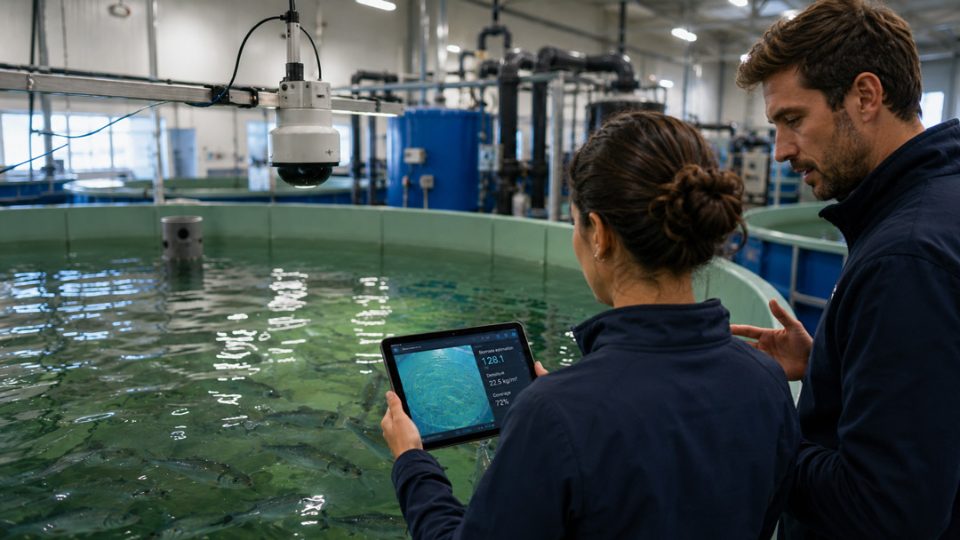
Of the 69 Portuguese patent families identified in the blue bioeconomy between 2004 and 2024, only two technologies directly related to aquaculture have been demonstrated in relevant environments: a system for measuring fish biomass in tanks and a polymeric material tested in a recirculating aquaculture system with European seabass.
These are the aquaculture exceptions within an innovation system that has shown an ability to conduct research and protect knowledge, but has faced far greater difficulties in validating developments outside the laboratory and turning them into solutions with productive applications.
This is one of the main conclusions of A Retrospective for Decisions – Blue Bioeconomy Portuguese Patent Signals 2004–2024, a study by B2E – Blue Bioeconomy CoLAB. The researchers examined 1,985 patent applications, selected 239 relevant documents and grouped them into 69 patent families with Portuguese priority.
The report states that 94% of the technologies analysed did not progress beyond the initial or intermediate stages of technological maturity. A total of 81% are concentrated at TRL 4 and TRL 5, corresponding mainly to developments validated in the laboratory but not yet demonstrated under operational conditions.
Only four families, representing 6% of the total, reached TRL 6 or TRL 7, stages at which a technology has been demonstrated in a relevant environment or under conditions close to real-world operation.
A system for estimating biomass on a fish farm
One of the two most advanced aquaculture patents relates to a method and system for measuring the volume and weight of biomass in farming tanks, with a 2015 priority date.
According to the documentation included in the patent, the technology was tested both in experimental tanks and on a commercial aquaculture farm. The system recorded an approximate error of 8% under laboratory conditions and 15% in the production environment.
Biomass estimation is a key variable in farm management, as it affects feed planning, growth monitoring, stocking density calculations, harvest forecasting and feed conversion ratio control.
The fact that the technology was tested on an operational farm distinguishes it from most of the developments identified in the study, for which evidence of performance remains limited to the laboratory.
However, the report does not establish whether the system was subsequently commercialised, licensed or permanently incorporated into a production facility. The TRL assessment is based exclusively on the information contained in the patent documents and not on an external verification of industrial implementation.
A polymeric material tested in RAS with European seabass
The second patent family directly linked to aquaculture and classified at TRL 6 concerns a polymeric material intended for use in production systems.
The technology, with a 2023 priority date, was demonstrated in a pilot-scale recirculating aquaculture system, or RAS, using European seabass as the farmed species. This validation places it among the small number of Portuguese blue bioeconomy developments to have progressed beyond a strictly experimental setting.
Materials adapted to aquaculture systems may have implications for component durability, maintenance, biosecurity, interaction with water and the behaviour of surfaces that come into contact with farmed organisms.
Nevertheless, the available information does not yet reveal how the material performs at commercial scale, its cost, its useful life or the advantages it could offer over materials currently in use. Nor has the existence of agreements with companies for its manufacture or industrial deployment been confirmed.
Plenty of patents, little operational demonstration
The contrast between these two technologies and the remainder of the portfolio highlights a structural weakness in Portuguese blue innovation. Portugal has increased its patenting activity and sought protection in markets including the United States, China and Europe, but most of the developments have not progressed far enough for their usefulness to be assessed under real-world conditions.
The problem does not appear to lie solely in the quality of the research, but also in the absence of mechanisms for maturing technologies beyond the proof-of-concept stage.
B2E CoLAB identifies the main barriers as a lack of shared pilot and demonstration infrastructure, complex regulatory and licensing procedures, and insufficient financial instruments to absorb the risks associated with scaling up.
The result is a portfolio containing a substantial number of patents but limited evidence of productive applicability. A patent protects an invention, but it does not guarantee that the technology will be technically viable at industrial scale, respond to a business need or reach the market at a competitive cost.
Nine patent families directly linked to farming
Of the 69 families analysed, nine, or 13%, are classified under the farming of fish, molluscs, crustaceans and marine invertebrates.
They are joined by technologies located elsewhere in the value chain, including animal feed, additives and immunonutrition. These account for between 7% and 9% of the portfolio and may include applications involving aquafeeds, fish health and immunity.
However, the study did not identify any patent family in the specific category of seaweed aquaculture. Genetics and other areas located in the early stages of production are also poorly represented.
These gaps are particularly relevant because they occur in areas considered strategic for diversification, production autonomy and the growth of European aquaculture.
To improve the situation, the study proposes developing infrastructure for pilot-scale testing, strengthening regulatory support and facilitating funding for the initial demonstration stages. It also highlights the need for greater involvement from research centres, CoLABs and companies in the development and validation of technologies.
The report further warns that many mature innovations lose patent protection. Although this may represent a loss for their original developers, it can also create opportunities for other companies to reuse or adapt technologies that are already available.

Related

Latest In-depth
-
Clams more resistant to heat and Perkinsus: research paves the way for selective breeding
Padua, Italy, 16/10/2026 | University of Padua researchers explain to misPeces the findings presented at Aquaculture Europe 2026 and the steps needed to transfer them to hatcheries. Initial applications could emerge within the next two or three years, although the relationship between resistance, growth and other production traits still need to be assessed