
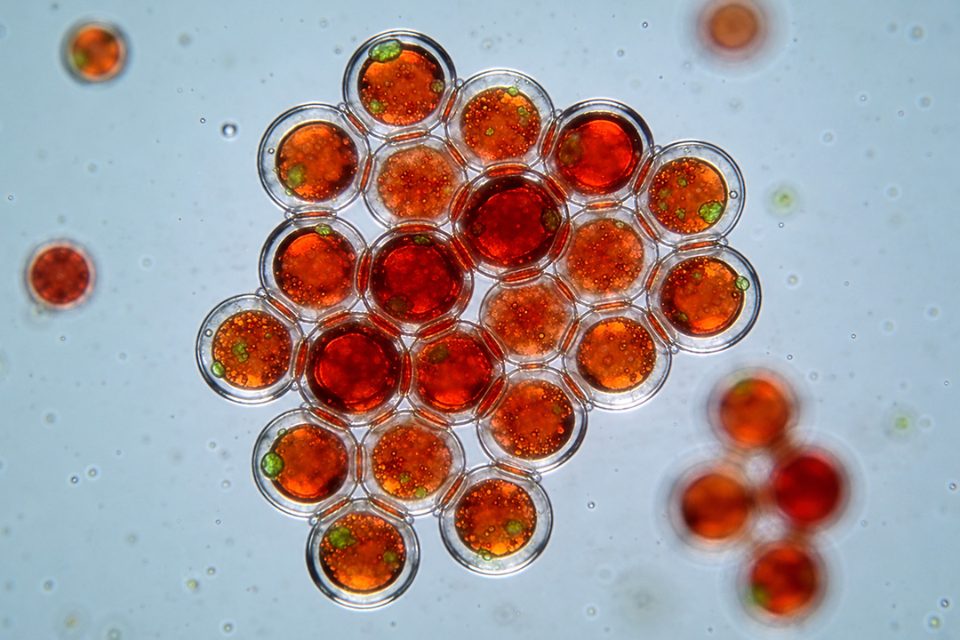
Recirculating aquaculture systems (RAS) reduce water consumption and allow production to be better controlled, but they do not fully eliminate the issue of residual streams. In daily operation, they generate water containing nitrogen and phosphorous, as well as CO2 -enriched degassing air. What is usually managed as waste, or as an environmental load, could become a raw material for producing high-value compounds.
This is the hypothesis assessed by a team from the University of Jyväskylä, in Finland, using the microalga Haematococcus pluvialis, one of the main natural sources of astaxanthin. This carotenoid is used in aquaculture as a pigment and functional compound, especially in salmonid feeds, although its natural version remains constrained by high production costs.
The interest of the study lies not only in producing astaxanthin, but in showing that two residual RAS streams — nutrients and CO2 — can become inputs for a higher-value biotechnology.
The study cultivated Haematococcus pluvialis in water from a rainbow trout RAS and compared two aeration sources: ambient air, with around 400 ppm CO₂, and exhaust air from a RAS, with CO₂ concentrations of 1,900 to 2,500 ppm. The cultures were grown at around 18 ºC, representative of Nordic facility conditions, and were subsequently exposed to high light intensity to induce astaxanthin accumulation.
The results show that CO₂ from the RAS increased the microalga’s growth rate by 15%, cell density by 57% and dry weight by 76% compared with ambient air. In addition, the removal of total nitrogen, nitrate and phosphate exceeded 95% in the treatments tested, strengthening the interest of this approach not only for biomass production, but also as a bioremediation strategy for effluent water.
The most relevant part from an industrial perspective appears during the light-stress phase, when Haematococcus pluvialis shifts towards the red phase and accumulates astaxanthin. The use of RAS-derived CO₂ during this phase increased astaxanthin content by 17% to 19%, reaching 1.12% of dry weight. Volumetric astaxanthin concentration increased by 92% to 119%, with values of up to 23.26 mg per litre.
According to the authors, this indicates that CO₂ extracted directly from a RAS can be sufficient to improve both growth and astaxanthin production compared with ambient air. The observation is important because it does not involve injecting pure CO₂ or external industrial gases, but rather making use of a stream already generated within the aquaculture facility itself.
Although the results are promising, in commercial settings system biomass fluctuates depending on the production stage, feed input and degassing efficiency, among other factors. In addition, exhaust air may contain traces of compounds such as ammonia, hydrogen sulphide or nitrous oxide, whose effects on the microalga need to be studied further.
The cost of photobioreactors, biomass harvesting and drying, extraction or direct use of the ingredient, the stability of CO₂ availability on a commercial farm and the final quality of the product must also be considered.
RAS side streams can therefore become biotechnological inputs if they are integrated with microalgae cultivation systems designed to recover nutrients, capture carbon and generate functional biomass.

Related

Latest In-depth
-
Clams more resistant to heat and Perkinsus: research paves the way for selective breeding
Padua, Italy, 16/10/2026 | University of Padua researchers explain to misPeces the findings presented at Aquaculture Europe 2026 and the steps needed to transfer them to hatcheries. Initial applications could emerge within the next two or three years, although the relationship between resistance, growth and other production traits still need to be assessed