
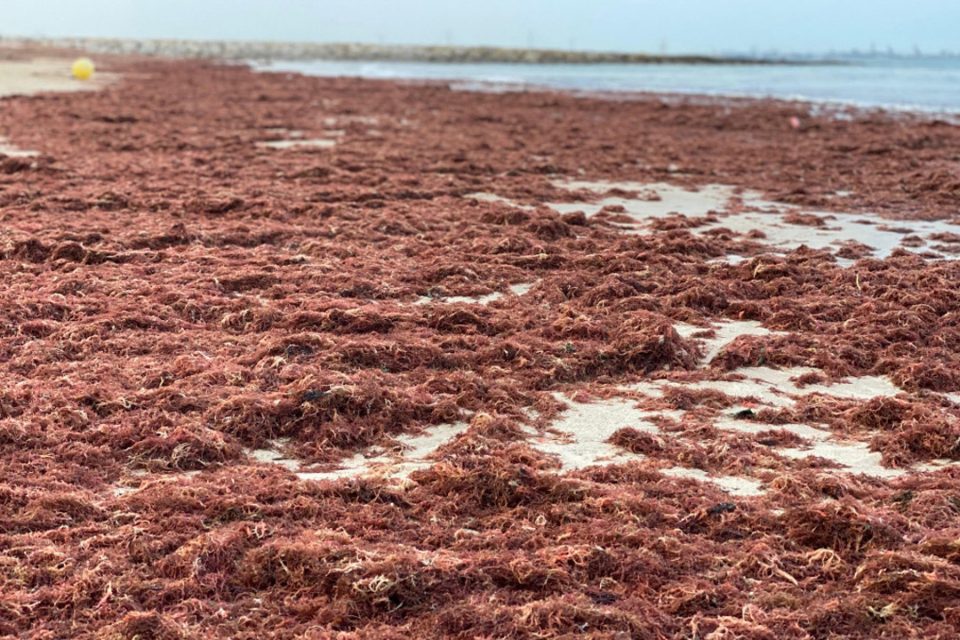
Seaweed blooms usually enter the public debate in summer, when large volumes reach beaches and have to be removed by municipal cleaning services, creating costs for local authorities and coastal businesses.
At that point, a recurring question arises: can this biomass be turned into a raw material for the marine bioeconomy?
The short answer is yes, but only under certain conditions. Seaweeds contain compound of interest, including sulphated polysaccharides, proteins, minerals, phenolic compounds and other ingredients with potential applications in functional foods, biomaterials, agriculture, cosmetics, bioenergy and even biomedical products.
However, turning a green tide into a resource is not simply a matter of collecting seaweed from the coast and taking it to a processing facility. It requires anticipation, traceability, quality control, robust industrial processes and markets capable of paying for value-added products.
The main difficulty is that beach-catch seaweed is highly variable. Its composition changes depending on the location, season, physiological state of the algae, level of degradation, salt content, microbial load, possible presence of contaminants and the time elapsed since collection.
For this reason, if the biomass is not detected early, characterised and processed quickly, much of its potential value may be lost before it even reaches industry.
Seaweed blooms are a global issue, although the way they are managed varied widely. In the Yellow Sea, China, recurrent green tides linked to the sea lettuce Ulva prolifera are among the most studied cases in the world.
There, scientists and public authorities have developed satellite monitoring tools, prediction models, early detection systems based on environmental DNA, and removal or source-control strategies.
The strategic shift is to move from reactive waste management to an organised chain of early warning, precise interception and high-value conversion.
For Europe, this model should not be copied directly, but it can provide a useful reference. The logic is to move from reactive waste management to an organised chain based on early warning, precise interception and high-value conversion.
Remote sensing technologies can estimate the size and evolution of algal patches. Hydrodynamic models can help predict their drift. Environmental DNA can detect propagules before the bloom becomes visible. These tools are just as important as the subsequent collection, treatment and valorisation of the biomass.
The main challenge is no longer to prove that seaweed compounds are interesting. This is already well documented, particularly in the case of ulvans and other sulphated polysaccharides. The real question is how to produce them consistently, safely and profitably.
Not all valorisation routes have the same level of maturity. Some remain at laboratory scale, others have advanced to pilot scale, and very few can be considered fully consolidated from an industrial perspective. In addition, the highest-volume applications are not always those with the greatest added value.
Taken together, seaweeds should be understood as a biorefinery platform rather than a single raw material. Their use may combine several outputs, ranging from low-value, high-volume products to more demanding and better-paid functional ingredients.
For the use to become viable in food, aquafeeds, animal health or functional applications, several aspects must be properly documented: dosage, stability, bioavailability, safety, extraction cost, applicable regulation and efficacy under real conditions.
The key question, therefore, is not simply whether seaweed has value, but which fraction of that biomass can be captured under suitable conditions, transformed with guarantees and sold in a market willing to pay for more than an environmental solution.
Without that complete chain, the resource becomes waste again.

Related

Latest In-depth
-
Clams more resistant to heat and Perkinsus: research paves the way for selective breeding
Padua, Italy, 16/10/2026 | University of Padua researchers explain to misPeces the findings presented at Aquaculture Europe 2026 and the steps needed to transfer them to hatcheries. Initial applications could emerge within the next two or three years, although the relationship between resistance, growth and other production traits still need to be assessed