
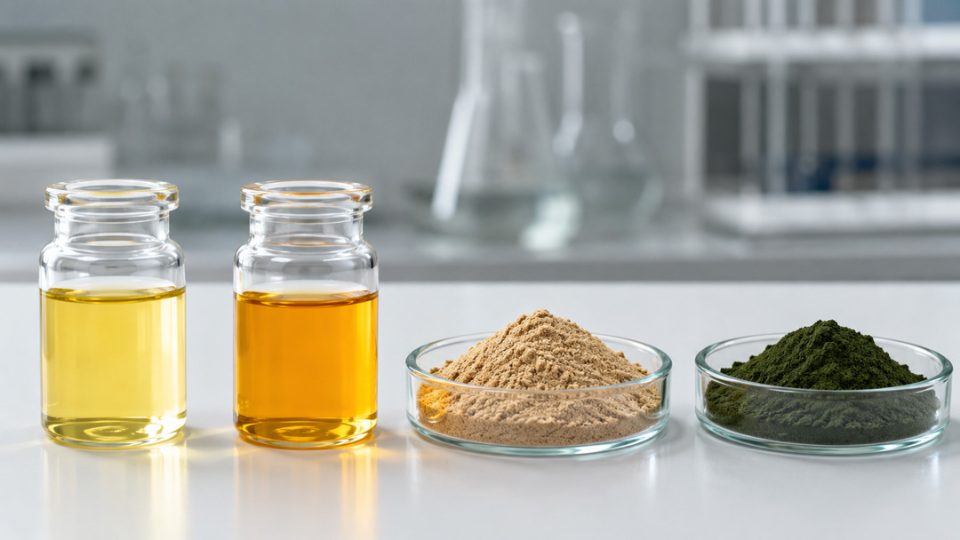
A European Commission guidance document on replacing fish-derived marine ingredients with algae-based ingredients concludes that substitution may be technically possible in some scenarios. However, in the short and medium term, the realistic pathway will be partial, gradual and combined with other alternative ingredients and fishery or aquaculture by-products.
The report Replacing fish-based feed with algae-based feed in aquaculture proposes an initial target whereby at least 25% of EPA and DHA in aquafeeds should come from non-fish-derived sources. The key issue is not so much the percentage of algae included in the formula, but the functional replacement of the marine omega-3s currently supplied by fish oil.
The key issue is not so much how much algae enters the feed, but what share of fish-derived EPA and DHA can be replaced without compromising performance, quality or cost.
1% algal oil does not equal 1% fish oil
This distinction is fundamental. One percent of microalgal oil does not necessarily equal one percent of fish oil. Because algal oil can contain higher concentrations of EPA and DHA, it can deliver the same nutritional value with a lower inclusion volume.
For example, a feed containing 12% fish oil could be reformulated with 9% fish oil and around 2% microalgal oil to achieve a 25% replacement of EPA and DHA. With more concentrated algal oils, the inclusion level could fall to 1.5% or less.
For this reason, microalgal oil should be assessed not only by its percentage inclusion in the formula, but also by its nutritional density, its stable supply of EPA and DHA and its capacity to reduce dependence on forage fish.
In terms of total inclusion, the European Commission considers technically feasible ranges of 10% to 15% algae-based ingredients in salmon and trout feeds, and 20% to 25% in feeds of European seabass and gilthead seabream.
These levels, however, do not mean that all commercial feeds can adopt them immediately. Feasibility will depend on the species, life stage, ingredient price, industrial availability, the nutritional profile of each microalga and the specific objective of the formulation.
Nor do all microalgae perform the same function. Schizochytrium sp stands out as a DHA source; Nannochloropsis oceanica as a source of EPA and protein; and Chlorella sp for its potential. As a result, algae should be understood less as a direct replacement of fishmeal and fish oil, and more as a formulation tool for adjusting omega-3s, protein, functionally, cost and sustainability.
Microalgae are not a single ingredient, but a family of raw materials with different functions: some provide DHA; others, EPA; others, protein; and others, functional compounds.
Algal oil and algae meal are not at the same stage of maturity
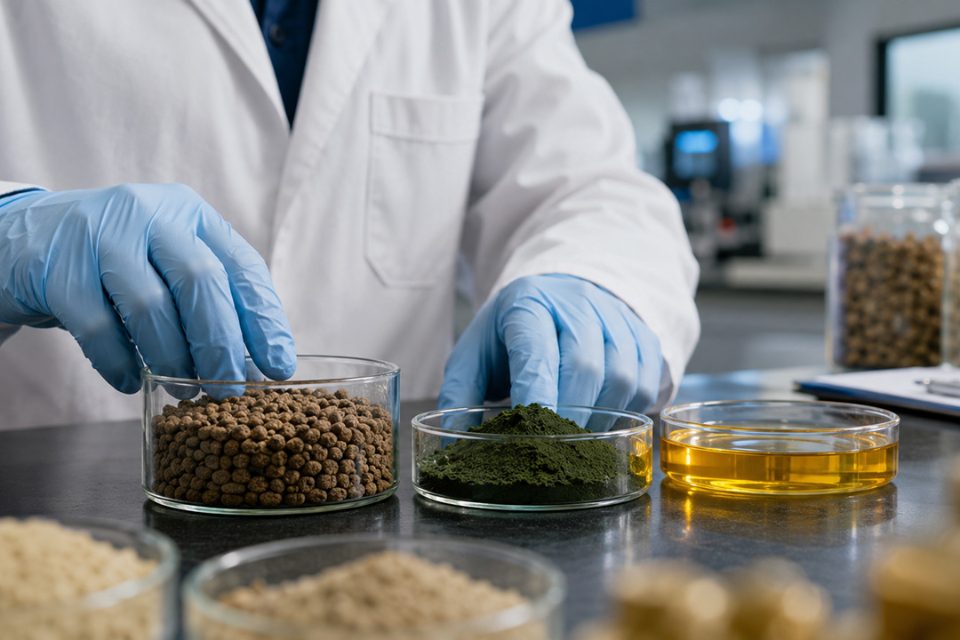
In the case of microalgal oil, its fit within aquafeeds in more direct. Microalgae are the primary origin of marine omega-3s in the food chain, so using algal oil allows EPA and DHA to be supplied from the original source, reducing dependence on forage fish.
Replacing fishmeal with algal biomass, however, is more complex. According to the report, industry experts consider that an inclusion level of around 3% algae meal in aquafeeds could be achievable within the next five years. However, they do not expect algae meal to become the main substitute for fishmeal in the short term.
Its most likely role will be as a functional ingredient, providing bioactive compounds, pigments, beta-glucans and potential benefits for fish health and quality.
Microalgal oil and microalgal meal are therefore not at the same level of commercial maturity. Algal oil already has established industrial applications, whereas algal biomass as a protein ingredient still needs further progress in processing, digestibility, cost and availability.
Digestibility depends on processing
Digestibility is another critical factor. Some microalgae have protein and amino acid profiles comparable to conventional ingredients, but their utilisation depends on processing. Species with resistant cell walls, such as Chlorella or Nannochloropsis, may require cell disruption or other treatments to improve nutrient availability.
Microalgae are not a single ingredient, but a family of raw materials with different functions: some provide DHA; others, EPA; others, protein; and others, functional compounds.
In the case of macroalgae, the approach should be even more cautious. The report notes that they can negatively affect growth and feed conversion when used as major substitutes, although at low levels, normally below 10%, they may act as functional ingredients, feeding stimulants or sources of compounds of interest.
The final limit is productive and economic
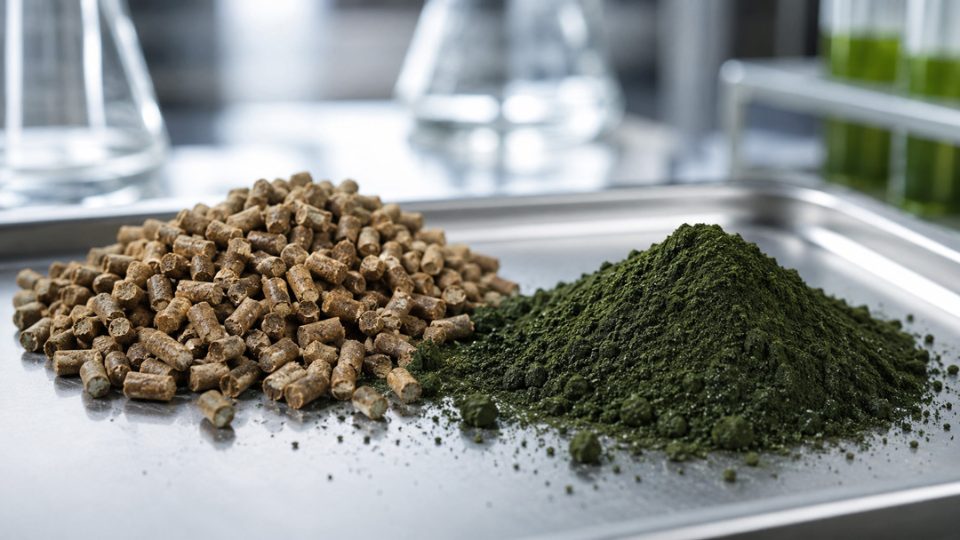
For producers, the real question is not whether the feed contains algae, but whether it maintains performance.
According to the European Commission, formulations containing algae-based ingredients can achieve results comparable to conventional feeds in terms of growth and feed conversion, while also improving fish quality and reducing exposure to contaminants such as dioxin and PCBs.
The limit remains economic. Microalgal oil is still more expensive in many formulations, although it offers stability, traceability and lower dependence on fluctuations in wild fish catches.
In a market where feed is one of the main production costs, any increase must be justified by performance, nutritional value, commercial differentiation or risk reduction.
The practical conclusion is that real inclusion levels must be assessed across three layers: nutritional, to replace part of the fish-derived EPA and DHA; functional, through the contribution of compounds related to health, pigmentation or quality; and economic, to determine whether the formula can be scaled under commercial conditions.
For Mediterranean aquaculture, the report opens up an opportunity, but also a warning. European seabass and gilthead seabream could technically tolerate high levels of algae-based ingredients, but adoption will depend on ensuring that cost does not further aggravate margins already under pressure from international competition and feed prices.
The key question, therefore, is no longer whether microalgae can enter aquafeeds, but at what percentage, with which species, for what nutritional function and with what return for the farm.
Related

Latest news
-
Financial model projects a 19.4% internal rate of return for an offshore European seabass farm off France
France, 23 October 2026 | The hypothetical operation would require nearly $40 million investment and produce 5,220 tonnes a year at full capacity. The projected return depends on assumptions that have yet to be tested at commercial scale
-
FEAP calls for binding fish farming production targets in EU's Vision 2040
Brussels, 22/10/2026 | European fish farmers welcome the Commission's plans to simplify aquaculture licensing but call for measurable growth targets, national commitments and a regulatory framework that supports investment
-
A rapid test for tilapia lake virus moves closer to on-farm diagnosis
Thailand, 22 October 2026 | A lateral flow test correctly identifies 60 out of 61 tilapia samples, offering a potential tool for preliminary virus detection, although further validation is needed to establish its ability to identify early-stage infections