
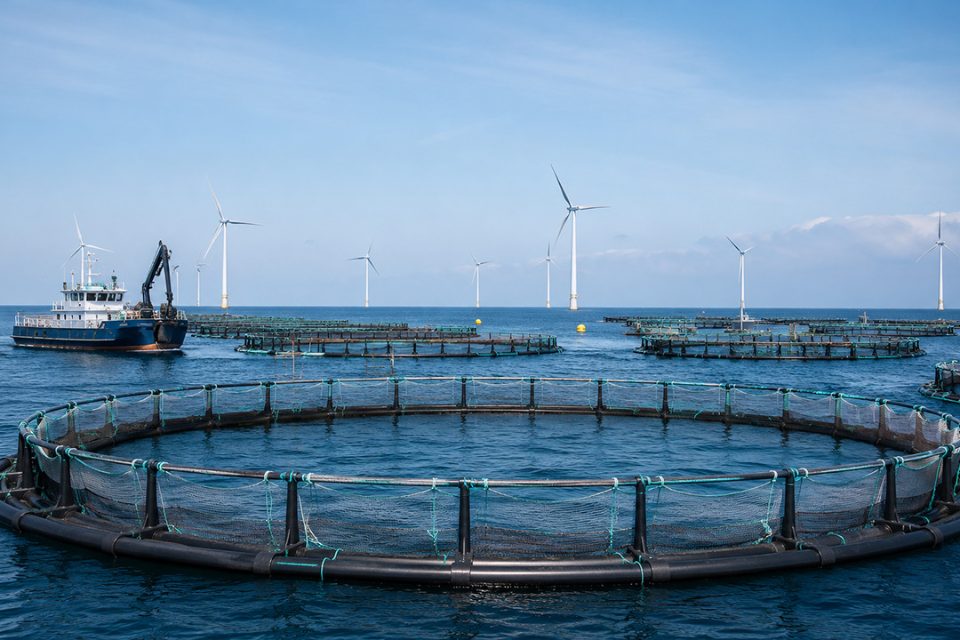
European aquaculture will only be able to reach climate neutrality by 2050 through a combination of direct emission reductions, feed transformation, energy efficiency, electrification, digitalisation, the development of non-fed systems and credible offsetting mechanisms.
This is one of the main conclusions of the report EU Aquaculture: Greenhouse Gas Reduction Costs and Pathways to Net Zero by 2050, prepared for the European Commission.
Among the conditions for reaching climate neutrality, the report identifies eight lines of action: driving energy efficiency and digitalisation, supporting the decarbonisation of feed and raw materials, accelerating the energy transition in transport and operations, strengthening breeding programmes, continuing to support IMTA and non-fed species, developing recognised offsetting methodologies, stimulating the market for low-carbon aquaculture products, and improving the regulatory and licensing framework.
The report measures the decarbonisation effort in euros per tonne of CO2 equivalent avoided. Costs vary depending on the time horizon, production system and actual scope for improvement.
In general, fed system offer more reduction opportunities, while non-fed aquaculture starts from a low footprint and therefore faces higher costs when reducing residual emissions.
| Area analysed | Estimated cost | misPeces editorial reading |
|---|---|---|
| Short term, 2026-2030 | 46–243 €/t CO₂eq | The cost will depend heavily on the type of measures applied and the initial pace of adoption. |
| Medium term, 2026-2040 | 65–232 €/t CO₂eq | Decarbonisation begins to require a broader mix of efficiency, energy, feed and management measures. |
| 2050 horizon, 2026-2050 | 69–228 €/t CO₂eq | Climate neutrality will require internal measures and offsetting for residual emissions. |
| RAS | 41–52 €/t CO₂eq | There is scope for improvement linked to energy efficiency, digitalisation and the electricity transition. |
| Ponds | 60–62 €/t CO₂eq | Costs sit within a moderate range among fed production systems. |
| Cages | 65–68 €/t CO₂eq | The reduction potential is strongly shaped by feed, logistics, energy and offshore operations. |
| Raceways | 66–72 €/t CO₂eq | Emission reduction depends on operational efficiency, energy use and feed improvements. |
| Non-fed aquaculture | 172–227 €/t CO₂eq | It starts from a low footprint, which makes reducing residual emissions more difficult and costly. |
One of the key points in the report is that fed aquaculture cannot fully decarbonise by acting only at farm level. Feed emerges as the main source of emissions in fed systems, as its production and transport account for a decisive share of the carbon footprint.
For this reason, the sector’s climate neutrality will also depend on the decarbonisation of raw material supply chain, agriculture, fisheries, transport and energy.
The document argues that internal measures – emerging feed materials, genetic improvement, artificial intelligence tools, renewable energy, energy efficiency, IMTA and greater share of non-fed species – will not be enough on their own to reach net zero emissions.
Even with broad adoption of these tools, residual emissions linked to energy, transport, infrastructure and feed will remain, meaning recognised and verifiable offsets will be required.
Link to report: EU Aquaculture: GHG Reduction Costs and Pathways to Net Zero by 2050

Related

Latest In-depth
-
Clams more resistant to heat and Perkinsus: research paves the way for selective breeding
Padua, Italy, 16/10/2026 | University of Padua researchers explain to misPeces the findings presented at Aquaculture Europe 2026 and the steps needed to transfer them to hatcheries. Initial applications could emerge within the next two or three years, although the relationship between resistance, growth and other production traits still need to be assessed