
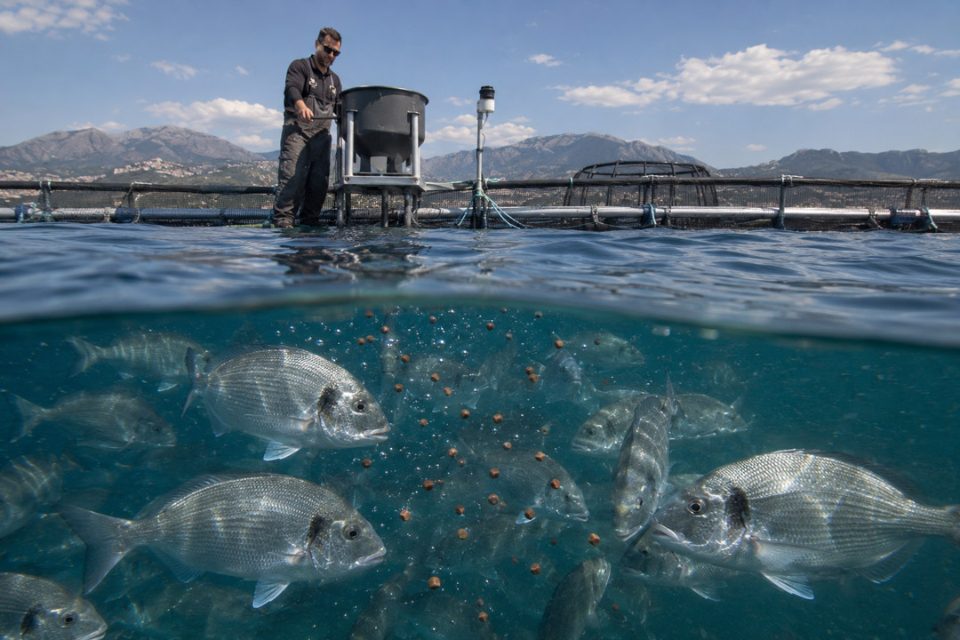
A study conducted by researchers from the Universities of Patras and Crete, Greece, has found no detectable genetic changes in wild gilthead seabream (Sparus aurata) populations in the Ionian Sea between 1994 and 2024, despite the expansion of marine aquaculture and repeated escapes from fish farms during this period.
The findings address one of the main environmental concerns associated with marine fish farming in Greece, particularly in an area where aquaculture has expanded considerably over recent decades.
The research, accepted for publication in the scientific journal Aquaculture, provides an unusually long-term perspective on interactions between aquaculture and wild fish populations.
Over the past three decades, numerous fish escape events have been documented at Mediterranean aquaculture farms, some involving large numbers of fish. However, the researchers found no significant changes in the genetic structure of the wild gilthead seabream populations examined, nor conclusive evidence of genetic ancestry originating from the farmed populations used as references.
The research team assessed genetic diversity using 15 microsatellite markers, examining differences between populations and the possible presence of genetic material originating from farmed fish.
The results showed a stable genetic structure over time. Differences between wild samples collected in different years were very small and not statistically significant.
The most direct comparison, between gilthead seabream sampled in Messolonghi in 1994–1996 and those collected at the same location in 2024, also revealed no significant differences.
Genetic differences between wild and farmed seabream
The researchers did, however, identify genetic differences between wild gilthead seabream and those originating from fish farms.
Farmed fish exhibited lower genetic diversity and considerably smaller effective population sizes. These differences may be associated with the limited number of broodstock used in hatcheries, as well as selective breeding and reproduction under captive conditions.
The analyses largely distinguished two genetic groups, corresponding to wild and farmed fish.
However, none of the wild-caught individuals showed genetic ancestry that could be conclusively attributed to the farmed populations examined.
Nor were any individuals identified with sufficient confidence as hybrids or descendants of backcrosses between wild and farmed fish.
Estimates of gene flow from the reference farmed populations into wild populations were close to zero, although they were subject to considerable uncertainty.
Why were no genetic changes detected?
The researchers suggest that the observed stability may be related to the biological characteristics of gilthead seabream and the natural genetic structure of its populations.
Unlike other species with more geographically differentiated populations, gilthead seabream exhibits high genetic connectivity across different areas of the Mediterranean.
Adult mobility and larval dispersal facilitate genetic exchange between wild populations. A potentially large effective population size may also help buffer the genetic consequences of limited contributions from escaped farmed fish.
The relatively low genetic differentiation between wild and farmed seabream could also help explain the absence of detectable changes.
However, the authors present these explanations as possible contributing factors rather than mechanisms whose effects have been conclusively demonstrated by the study.
Despite the findings, the researchers recommend maintaining measures to prevent fish escapes and strengthening genetic monitoring through periodic genomic analyses of wild populations and regularly updated genetic reference data for farmed stocks.
Scientific reference: Geladakis, G., Anastasiadi, M., Papaioannou, C., Koumoundouros, G., Dimitriou, E., Koutsikopoulos, C. and Batargias, C. (2026). Three decades of Mediterranean aquaculture expansion without detectable genetic change in wild Gilthead seabream (Sparus aurata) populations. Aquaculture. Accepted manuscript, pending final publication. DOI: https://doi.org/10.1016/j.aquaculture.2026.744709

Related

Latest In-depth
-
Enrico Bachis: Fishmeal and fish oil production to recover in 2027
Sardinia, 16 November 2026 | global fishmeal production will reach 4.44 million tonnes in 2026, the lowest figure in IFFO’s historical series and fish oil production is expected to be around 1.15 million tonnes, its lowest level since 2016