
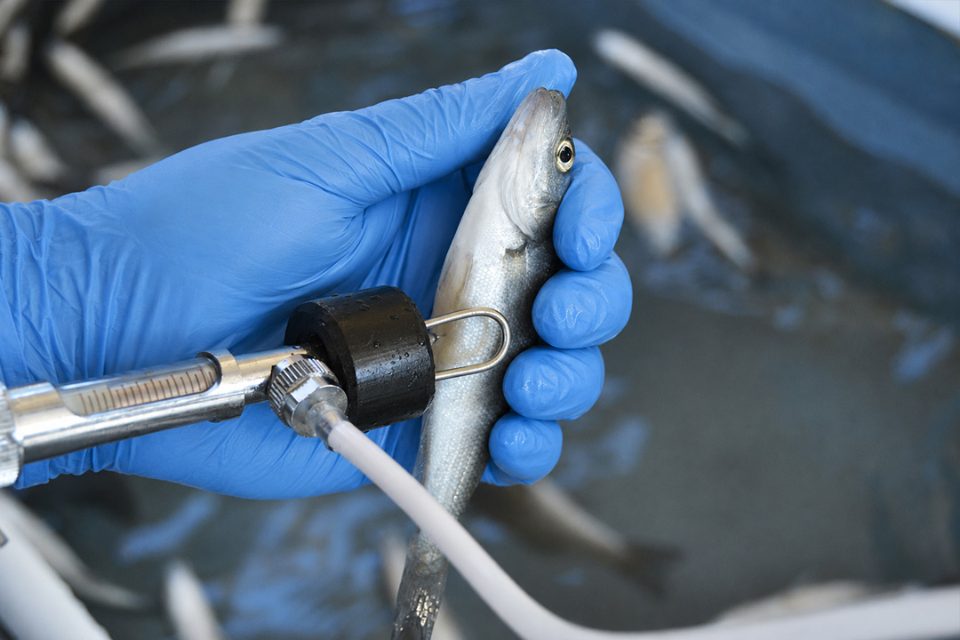
A vaccine can perform well in the laboratory and behave unpredictably when applied under commercial conditions. The reason is that, on a farm, a vaccine does not act on an isolated fish or in a stable environment, but within a system shaped by temperature, dissolved oxygen, water quality, ammonia accumulation, stocking density, handling stress, animal genetics, age at vaccination, co-infections and the diversity of pathogen strains.
This means the relevant question is not only whether a vaccine works, but when it works, for how long, against which pathogen, under what environmental conditions and with what real impact on mortality, transmission and production performance.
A review published in Reviews in Aquaculture describes this situation as a “black box” in fish vaccinology. The inputs are known — vaccine, dose, delivery route and timing — and the final outcome can be observed — greater or lower protection — but the mechanisms explaining why protection appears, weakens or fails are still only partly understood.
Vaccine efficacy is not a fixed property of the product. It is the result of an interaction between vaccine, fish, pathogen and environment.
This approach requires a rethink of how efficacy is measured. Lower mortality does not always mean that infection has disappeared, that the pathogen has stopped circulating or that transmission has been reduced. A vaccine may protect against one specific strain and be less effective against another; it may work during one phase of the production cycle and lose protection later; or it may generate measurable antibodies without guaranteeing a sufficient response in the tissues where infection begins.
In fish, this point is especially important because the gills, skin and gastrointestinal tract are not merely physical barriers. They are active immunological surfaces, permanently exposed to water, microbiota and infectious agents. Many pathogens enter precisely through these routes.
Injectable vaccines usually generate strong systemic responses, particularly in terms of circulating antibodies. Oral, immersion or mucosal vaccines seek to activate local defences at the pathogen’s points of entry. No strategy is universally superior. Its usefulness depends on the species, fish size, pathogen, stage of the production cycle and real farming conditions.
The environment and farm management also shape the response. Temperature determines the speed and intensity of the immune response; dissolved oxygen, water quality and ammonia can compromise the gills, intestine and immunity; and the stress associated with capture, handling or injection can alter the fish’s physiological response.
Vaccinating outside the right conditions can reduce protection even when the vaccine is well designed.
The review argues that the sector needs to move towards more transparent and predictive vaccinology. This means better pathogen characterisation, longer and more comparable field trials, integration of environmental data, measurement of immune responses beyond antibodies, and improved post-vaccination surveillance.
For the farm, the implication is clear: a vaccine should not be assessed only as a product, but as part of a production system. Recording variables such as temperature, oxygen, water quality, vaccinated batch, delivery route, fish size, mortality, lesions, pathogen load and production performance would make it easier to understand why a vaccine protects under some conditions and not under others.
Vaccination will remain a central part of aquaculture health management. But its value will increasingly depend on the sector’s ability to move from a logic of “product applied, outcome observed” to one of “system understood, risk managed”.
The future of fish vaccines is not only about developing better formulations. It is also about applying them better, measuring them better and understanding the conditions that make real and durable protection possible.

Related

Latest In-depth
-
Clams more resistant to heat and Perkinsus: research paves the way for selective breeding
Padua, Italy, 16/10/2026 | University of Padua researchers explain to misPeces the findings presented at Aquaculture Europe 2026 and the steps needed to transfer them to hatcheries. Initial applications could emerge within the next two or three years, although the relationship between resistance, growth and other production traits still need to be assessed