

An organised futures market can be a useful tool for perishable biological products, as shown by the experience of maize, soybean, coffee, sugar or livestock.
When supported by a solid commercial infrastructure, with standardisation, liquidity and trust in the price reference, it allows producers and buyers to hedge against price increases or falls, provides signals on market expectation, supports commercial planning and can attract financial capital into a more transparent value chain.
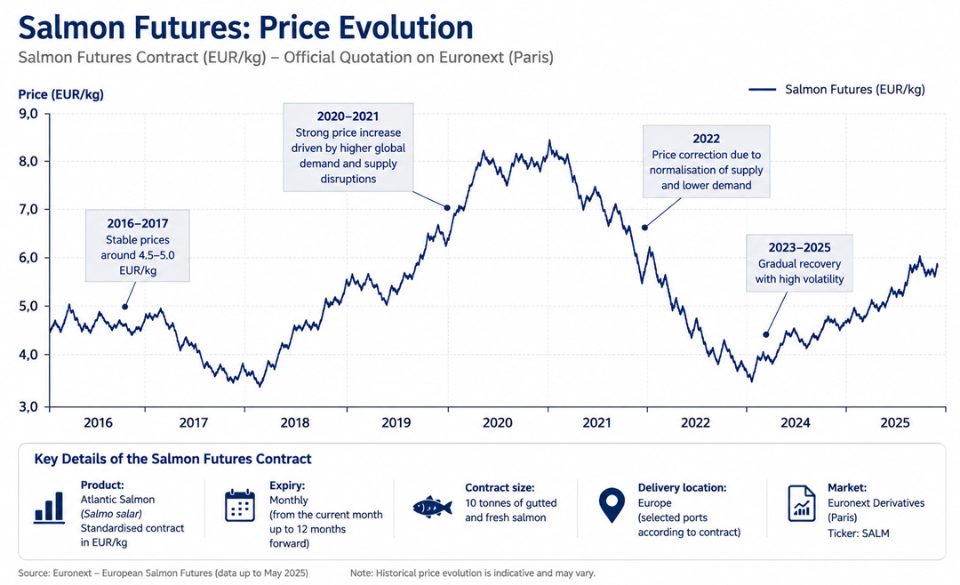
Salmon has so far been the main aquaculture case with an active organised futures market and international continuity. An analysis published in Aquaculture Economics & Management, covering the period from July 2006 to June 2024, shows that in practice even this market has important limitations: low liquidity, a weak relationship with general stock market risk, and its own patterns of seasonality and autocorrelation, which prevent it from being considered a conventional financial asset.
Although the market started well and salmon futures grew between 2006 and 2011, it soon stopped gaining liquidity. Between 2007 and 2022, traded volume presented only around 4% to 11% of physical production.
The small size of the futures market compared with the real salmon market prevented it from becoming a hedging benchmark for the whole industry. A liquidity problem was also observed. With so few transactions, it is difficult for a company to enter or exit a position when needed, reducing the usefulness of the contract as a risk management tool.
In illiquid markets, futures may provide price signals, but they do not guarantee useful hedging if producers and buyers cannot execute real transactions with sufficient market depth.
The most relevant point of the study is not that salmon futures fail against classic financial models such as the CAPM or the Fama-French three-factor model, but that they show the extent to which price remains shaped by biology, seasonality and the commercial structure of the industry.
The study of salmon futures offers a lesson for the gilthead seabream and European seabass markets. Before these species can become tradable financial assets, the sector needs to build a minimum market infrastructure based on reliable price indices, comparable historical series, data by origin and size, import monitoring, feed and energy costs, and tools to measure real margins.
This is where these markets still show important weaknesses. It is difficult to create a future price that accurately reflects the real price received by a specific producer.
A fresh domestically produced gilthead seabream sold through a particular channel may not behave in the same way as an imported seabream or a different size, with different logistics and a different commercial positioning. If the financial reference does not match commercial reality, the hedge may fail.
Without this base, a futures contract for gilthead seabream or European seabass could create more noise than protection. It might attract financial attention, but it would not solve the main problem facing producers: managing price risk in a fragmented market, under import pressure and with limited real-time transparency.
Financial sophistication is no substitute for market intelligence. Before futures for gilthead seabream and European seabass, the Mediterranean needs reliable data, transparent prices and sufficient commercial liquidity.

Related

Latest In-depth
-
Clams more resistant to heat and Perkinsus: research paves the way for selective breeding
Padua, Italy, 16/10/2026 | University of Padua researchers explain to misPeces the findings presented at Aquaculture Europe 2026 and the steps needed to transfer them to hatcheries. Initial applications could emerge within the next two or three years, although the relationship between resistance, growth and other production traits still need to be assessed