
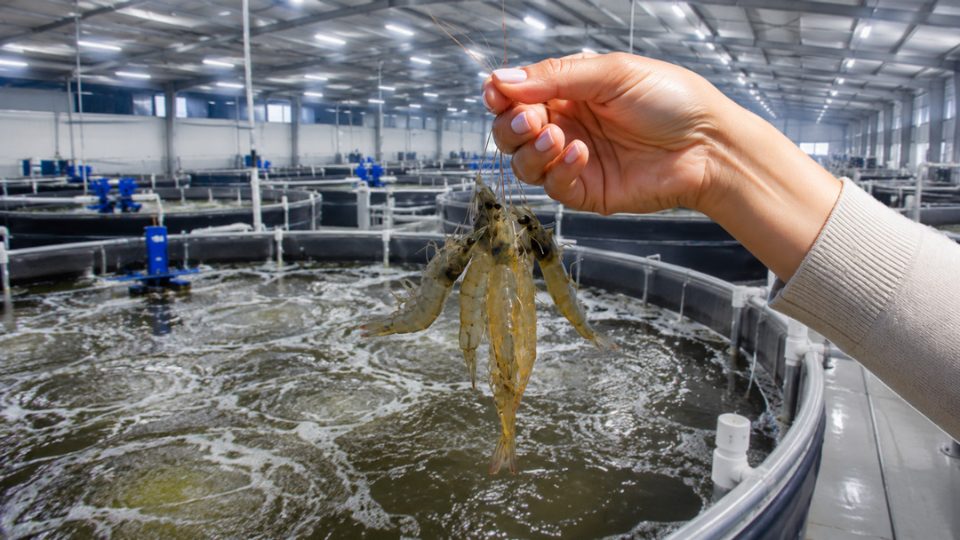
Whiteleg shrimp (Penaeus vannamei) has become one of the most versatile species in global aquaculture. Its environmental tolerance, fast growth and strong commercial demand have allowed its farming to expand beyond traditional coastal areas into inland low-salinity systems, using groundwater reused water or artificial saline mixtures.
This expansion creates production opportunities in semi-arid regions or areas far from the coast, reduces pressure on coastal ecosystems and enables the design of systems with greater sanitary control.
However, it also introduces a technical challenge that is not always well understood: farming shrimp far from the sea is not simply a matter of using water with less salt.
Low salinity can be viable, but only if the water maintains a chemical composition compatible with the animal’s physiology.
In inland systems, the problem is not usually only the total amount of salts, but the imbalance between essential ions such as sodium, potassium, magnesium and calcium. When these ratios are not properly adjusted, shrimp must spend more energy regulating their internal balance, which can result in lower growth, poorer feed conversion, higher stress and greater sensitivity to pathogens.
Where are the ideal production limits?
Scientific evidence, gathered in a study published in Critical Insights in Aquaculture, shows that the tropical shrimp (Penaeus vannamei) can perform well at moderate salinities, especially between 5 and 15 ppt, provided that the ionic composition of the water is adequate. Some studies even place the area close to physiological optimum at around 17 ppt.
At very low salinities, especially between 0 and 3 ppt, shrimp spend more energy on osmoregulation and have less energy available for growth. If the ions in the water are not corrected and the diet is not adapted, stress, moulting problems, poorer feed conversion and sanitary vulnerability increase.
For this reason, diets designed for these low-salinity systems cannot simply be adapted versions of conventional feeds. They must take into account higher requirements for energy, minerals, essential fatty acids and nutrients that help support shrimp physiology.
How are low-salinity RAS, BioRAS or biofloc systems managed?
In low-salinity RAS, BioRAS or biofloc systems, management does not depend only on filtering or renewing water, but on maintaining stable water quality, ionic balance, microbiota, feeding and organic load.
At low salinity, production, animal health and water form a single system. For shrimp to grow well, ammonia and nitrite peaks must be avoided, organic load must be controlled, the diet must be adjusted and an adequate mineral matrix must be maintained.
In RAS and BioRAS, it is essential to control recirculation, solids removal, biofiltration, pH and water mineralisation, correcting elements such as potassium, magnesium, calcium and phosphorous.
In biofloc systems, the priority is to maintain an active microbial community capable of transforming nitrogen, stabilising the system and providing complementary natural feed.

Related

Latest In-depth
-
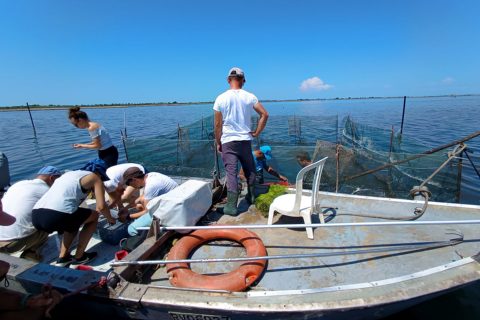
Clams more resistant to heat and Perkinsus: research paves the way for selective breeding
Padua, Italy, 16/10/2026 | University of Padua researchers explain to misPeces the findings presented at Aquaculture Europe 2026 and the steps needed to transfer them to hatcheries. Initial applications could emerge within the next two or three years, although the relationship between resistance, growth and other production traits still need to be assessed