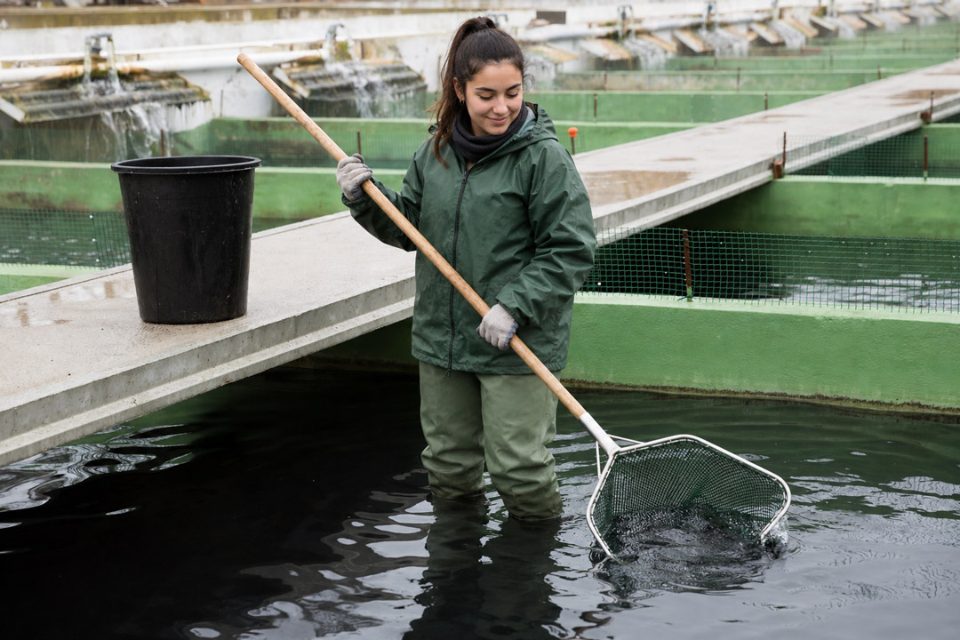
Women make up only 22% of the workforce in EU aquaculture production, according to European demographic data examined in a new report on gender equality in fisheries and aquaculture.
The situation is particularly uneven across the Mediterranean: despite the region’s importance for European aquaculture, the scale of its industry has not led to balanced female participation across species, farming systems or professional responsibilities.
One of the region’s main strengths is shellfish farming. In Spain, approximately 85% of female aquaculture employment is concentrated in this sector, with women accounting for more than half of the jobs associated with intertidal shellfish harvesting.
Women are also increasingly visible in research, hatcheries, fish health, quality assurance, environmental management and certification — strategically important areas for an industry facing climate change, animal-health, production-efficiency and environmental challenges.
| Production system | Female employment |
|---|---|
| Sea cages | 13% |
| Recirculating aquaculture systems (RAS) | 20% |
| Hatcheries and nurseries | 22% |
Note: Figures refer to employment across European aquaculture systems and are not specific to Mediterranean countries. Source: European Commission report.
Nevertheless, female participation remains particularly low in production systems traditionally associated with physically demanding work and offshore operations. Across Europe, women account for around 13% of employment in sea cages, compared with 20% in recirculating aquaculture systems and 22% in hatcheries and nurseries.
This is especially relevant in Mediterranean marine aquaculture, where European seabass and gilthead seabream production relies heavily on cage farming: the region may therefore sustain a major aquaculture industry while still providing relatively limited access for women to its core farm operations.
The available data also reveal considerable occupational segmentation. Women tend to have a stronger presence in marketing, labelling, administration and quality, organic and environmental certification than in production management, company leadership and senior decision-making.
The figures used in parts of the demographic analysis refer to 2017 and should not be presented as a current measurement, but they highlight structural inequalities that more recent and detailed employment statistics will need to assess.
Digital monitoring, automation, biotechnology, selective breeding and land-based production could gradually change this situation by creating roles increasingly based on technical qualifications.
Technological change alone, however, will not guarantee equal career progression if women continue to encounter barriers in recruitment, promotion and access to senior management.
Preliminary findings cited in the report reinforce this concern: 29% of female respondents to a European blue-economy survey said they had experienced gender discrimination within their organisation, while only 57% believed they had the opportunities needed to develop their careers, compared with 78% of male respondents.
Mediterranean aquaculture therefore combines a strong research base, female participation in shellfish-related activities and growing demand for qualified professionals with a persistent weakness: women remain concentrated in certain functions and have yet to gain comparable access to operational management and business leadership.
The contrast with fish processing is particularly significant, as women represent 56.2% of its workforce.
Closing the gap will require more than increasing overall employment; it will depend on whether women can participate fully in the technical, operational and managerial roles shaping the future of Mediterranean aquaculture.

Related

Latest In-depth
-
Clams more resistant to heat and Perkinsus: research paves the way for selective breeding
Padua, Italy, 16/10/2026 | University of Padua researchers explain to misPeces the findings presented at Aquaculture Europe 2026 and the steps needed to transfer them to hatcheries. Initial applications could emerge within the next two or three years, although the relationship between resistance, growth and other production traits still need to be assessed