
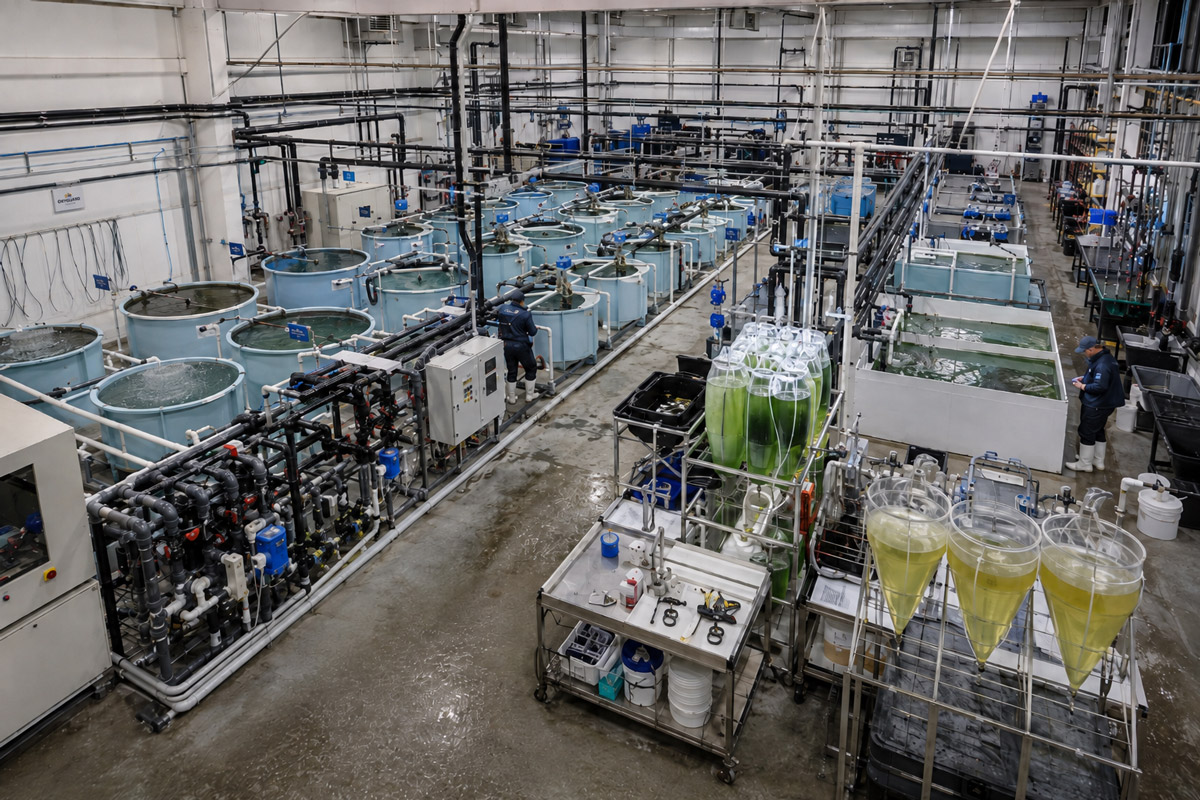
Building a hatchery is not simply a matter of installing tanks and equipment around a RAS system and switching it on. Before the first juvenile is produced, the facility requires specices-specific engineering and careful planning to coordinate all the biological processes involved: reproduction, egg incubation, larval rearing and feeding, and weaning through to the juvenile stage.
All of this must take place under strict control of water quality, biosecurity and facility equipment. Every decision made during the design stage will sooner or later affect operating costs, and its consequences can extend all the way into the grow-out phase, well beyond the hatchery itself.
Egg size, duration of the larval stage, excepted survival rates, nutritional requirements and the size and which juveniles will be sold determine culture volumes, the number of separate circuits, water-treatment requirement and, ultimately, the overall dimensions of the facility.
Retrofitting a hatchery to accommodate biological requirements that were not sufficiently considered in the original design can prove extremely costly.
An investment that can exceed EUR 12 million
As an order of magnitude, a commercial marine juvenile production facility can require an initial investment of around EUR 12-14 million, although the final figure will depend on the species, production capacity, location, level of automation and technology selected.
Two areas account for a large share of this financial commitment. The first is civil works: earthworks, foundations, structures, enclosures and the compartmentalisation require to keep different production areas physically separated.
The second is water treatment and recirculation systems, which must serve units with very different requirements, including broodstock, incubation, larvae, live feed and pre-grow-out.
Estimates for projects of this type suggest that civil works and RAS system together can account for most of the CAPEX, with seawater intake infrastructure, laboratories, IT systems and dedicated phytoplankton production units making up the remainder of the investment.
More important than the exact percentage allocated to each component is the way the interact. Saving money on an element that subsequently limits environmental control, biosecurity or production capacity can ultimately generate much higher costs once the facility is operating.
Public funding has historically helped lower the investment barrier for some aquaculture projects and can play a significant role in their financing. But even where support is available for the initial investment, the economic sustainability of a hatchery is determined later, once production begins and recurring costs start to accumulate.
OPEX begins where construction ends
If capex determines how much capital is required to build the hatchery, OPEX determines how much it costs to keep it producing every day. And the cost structure differs considerably from that of a conventional grow-out farm.
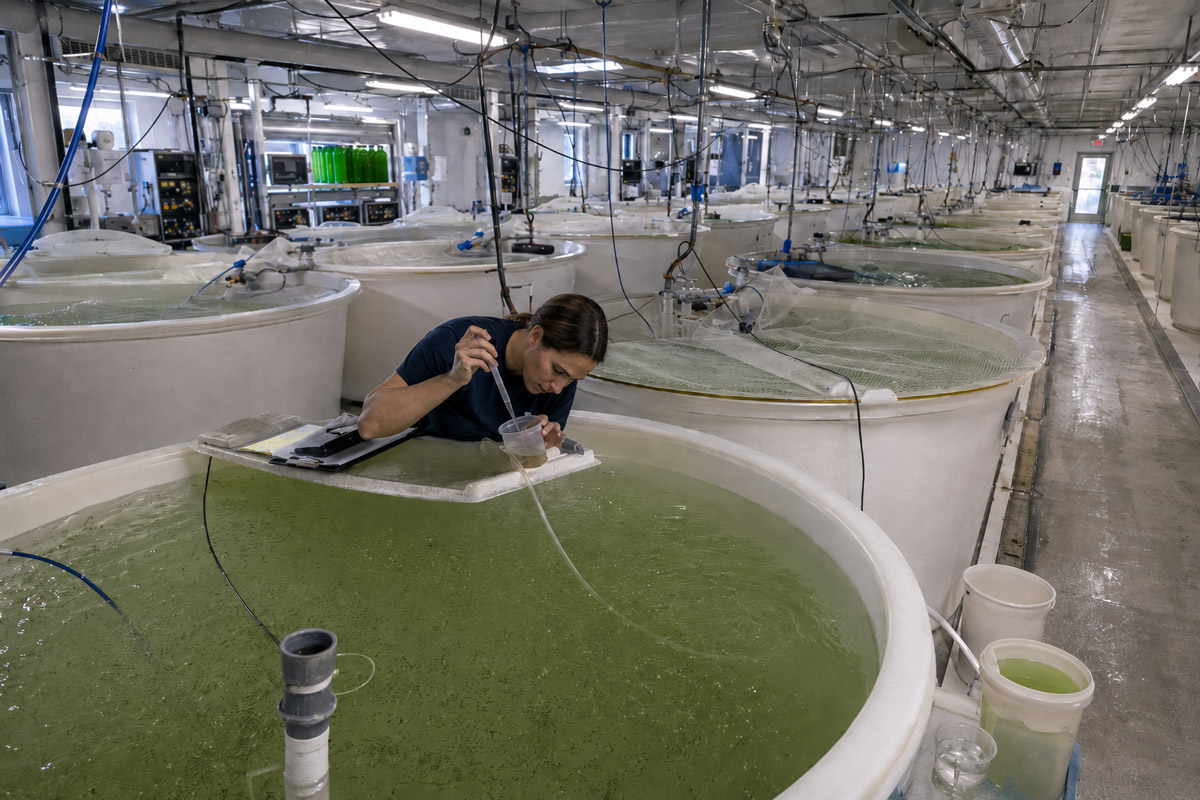
Feed is usually one of the main operating expenses. During the earliest stages, larvae depend on microalgae, rotifers and Artemia before completing the transition to formulated microdiets. This means maintaining a small parallel production chain for live feed within the hatchery itself, with its own equipment, staff, microbiological controls and energy requirements.
Energy is another critical component. RAS can drastically reduce water renewal and consumption compared with open-flow configurations, but this shifts much of the environmental control to pumping, filtration and treatment equipment that must operate 24 hours a day, requiring a reliable energy supply.
Another factor is difficult to automate completely: the need for specialised personnel. Selecting viable eggs, assessing larval development, managing live-feed cultures, monitoring microbiological parameters and identifying deviations before they affect a batch all require technicians capable of making rapid decisions.
In a hatchery, just a few hours can separate a controlled incident from the loss of an entire production batch.
Health management, vaccination where applicable, disinfectants and system maintenance complete the cost structure, alongside a less viable expense: the capital invested in the facility itself.
Depreciation on infrastructure worth several million euros, together with the associated financing costs, can weigh as heavily as some of the main biological operating below the production capacity for which it was designed.
Biosecurity has to be designed in from the start
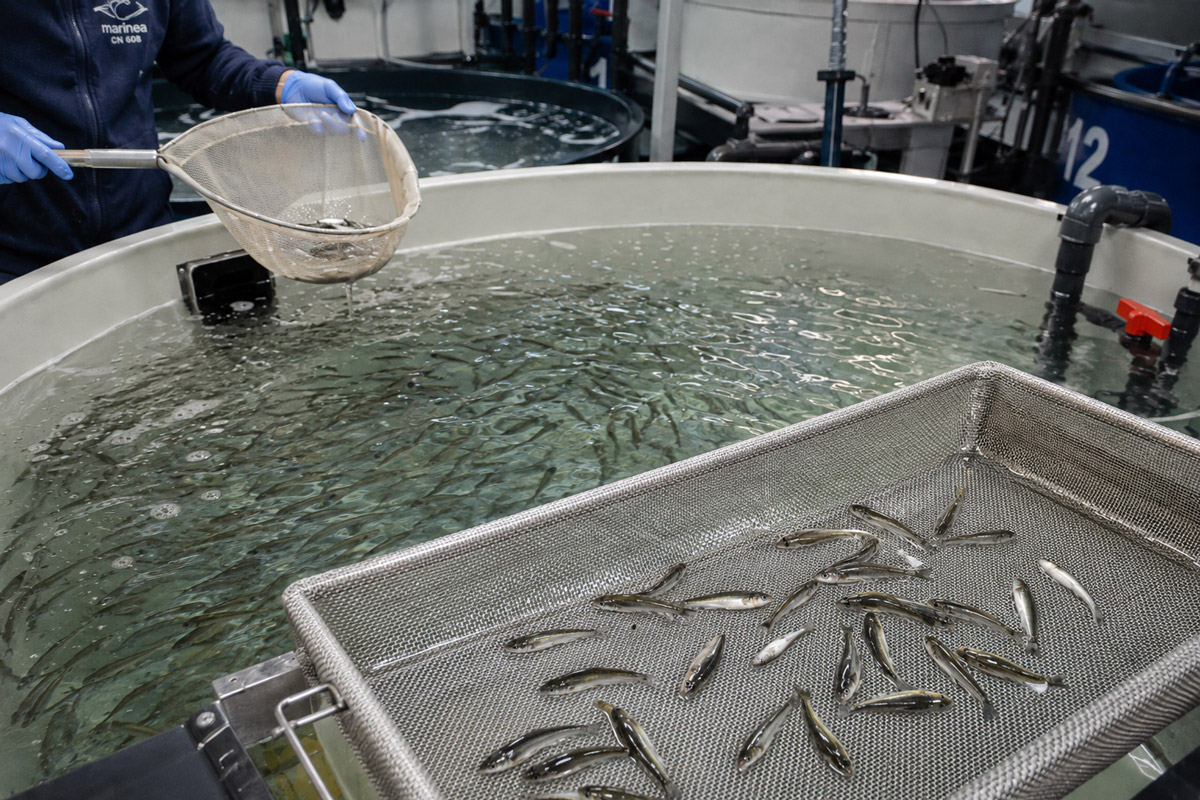
There is one area where correcting shortcomings after construction can be particularly expensive: biosecurity. Early life stages are highly sensitive, stocking densities can be high, and a health incident can compromise a valuable production batch in a very short time.
Microbiological water quality, filtration, ultraviolet or ozone disinfection, physical separation between units, staff movement and entry protocols should all be integrated into the facility from the initial design stage rather than added later. Independent circuits make it possible to isolate processes and limit the spread of incidents, although they also add complexity to the facility.
It is precisely this need for control that makes hatcheries one of the most compelling applications of recirculation technology in marine aquaculture. Their value lies not only in water reuse, but also in the ability to control environmental conditions, separate batches, manage reproduction and reduce exposure to external fluctuations during some of the most sensitive stages of the production cycle.
The outcome of all these decisions cannot be measured simply by the number of juveniles produced. A hatchery must supply uniform, robust juveniles with a high health status, giving grow-out farms the best possible starting point for the production cycle.
An apparently small difference in survival, growth or juvenile quality can be magnified once hundreds of thousands of fish move into the grow-out phase.
Related

Latest news
-

Alternative diets maintain gilthead seabream acceptance in consumer trial
Castellón, Spain, 15 October 2026 | A study by IATS-CSIC and Miguel Hernández University assesses how formulations containing alternative proteins affect fish texture, flavour and consumer ratings
-
Authorisation barriers hinder access to biocides in European aquaculture
Brussels, 15 October 2026 | Administrative delays and a small market complicate the availability of products for disinfecting facilities and controlling biofouling
-
Ozone or peracetic acid: how to disinfect a RAS without compromising biofilter performance
Norway, 16 October 2026 | A study involving Atlantic salmon compares two disinfection strategies against Yersinia ruckeri, highlighting the need to balance bacterial control, fish health and nitrification stability