Changing the physical characteristics of fish faeces through the feed itself could provide a new tool for improving solids management in recirculating aquaculture systems (RAS).
A study carried out by researchers at the Fisheries Research Station of Baden-Wüttemberg and the University of Konstanz has shown that incorporating 3% cork oak (Quercus suber) into Atlantic salmon feed reduces faecal density sufficiently to make the faeces float, allowing them to be removed before they break down within the recirculating system.
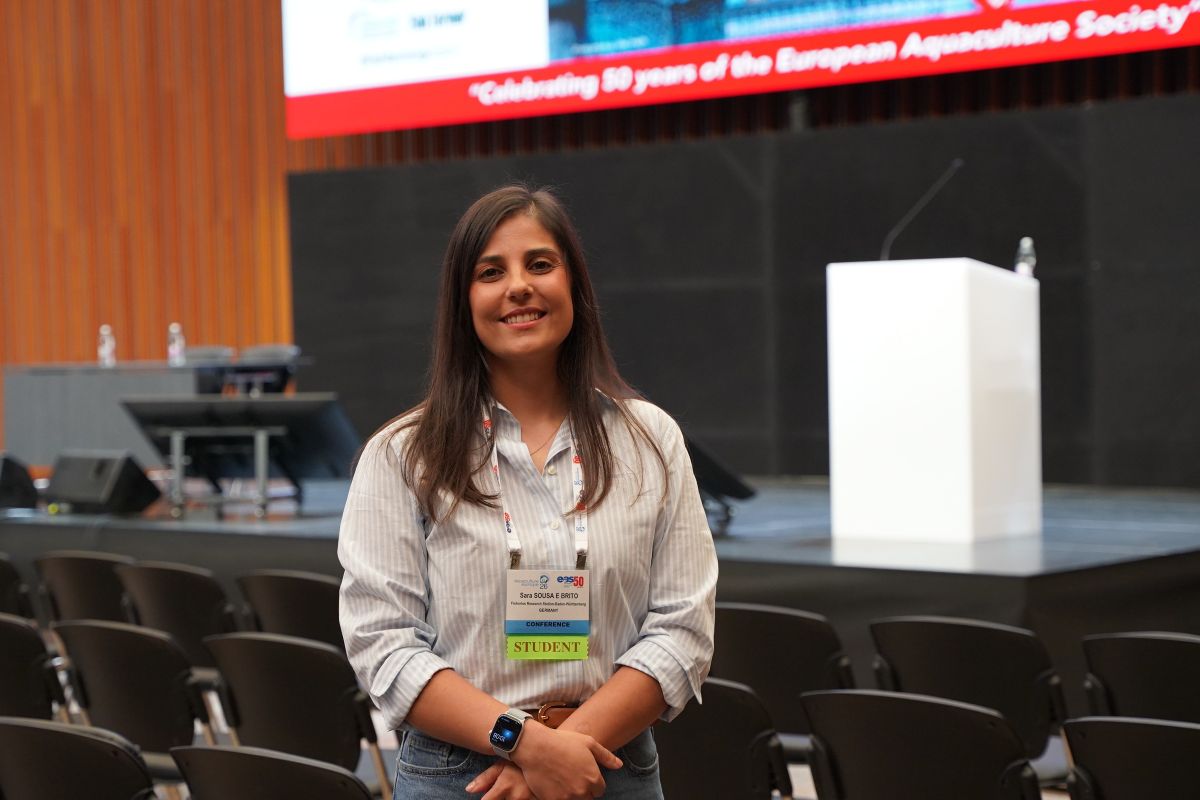
The work, led by researcher Sara Sousa Brito, received one of the EAS Spotlight Award at Aquaculture Europe 2026 in Ljubljana, Slovenia, following a public vote.
The 21-week trial was conducted in a semi-technical RAS for the freshwater phase of Atlantic salmon, comparing a commercial reference feed with an experimental diet containing 3% cork granules measuring between 0.7 and 1 millimitre.
Cork’s low density, closed-cell structure, low liquid permeability and resistance to degradation allow it to remain embedded within the faecal material during gastrointestinal passage and subsequently promote flotation.
The most significant result was seen in waste management. Drum filter solids removal efficiency reached 86.5%, compared with 42.4% for the control diet, while the surface removal system captured around 60% of the estimated solid loads.
“The idea of my work is changing the fish faecal characteristics to improve solids removal in RAS,” Sousa Brito told misPeces. With the addition of cork, she added, “we would improve considerably the amount of phosphorous, nitrogen, and solids being removed by the drum filters”.
The approach also increased the proportion of particle-bound nutrients removed from the system: removal efficiency reached 90.3% for total phosphorous and 69.8% for nitrogen, compared with 9.7% and 41.7%, respectively, in the control treatment.
Rapidly removing faeces from the water loop reduces their exposure to turbulence and therefore limits fragmentation and nutrient leaching into the water.
The cork treatment was also associated with a 10% reduction in CO2 levels. “The water quality was improved without compromising fish growth and survival,” the researcher said.
The “floating faeces” concept had previously been investigated by the team in rainbow trout, both in flow-through and recirculating systems, but this is the first application in Atlantic salmon in a full RAS with low water exchange.
In this trial, cork inclusion produced no significant differences in survival or feed conversion: FCR was 1.12 compared with 1.15 in the control, while survival reached 99.93% compared with 99.70%.
Significant improvements were, however, observed in specific growth rate, thermal growth coefficient and protein efficiency ratio.
The challenge now is to determine whether these results can be reproduced at commercial scale. Sousa Brito considers longer-term trials in commercial facilities necessary to validate both production performance and the long-term effects on system biology.
Shel also believes the technology is ready to take that next step and is seeking collaboration with industry. “Our product is ready to test in commercial facilities, and I would really like to have that opportunity together with the industry to make this product a real scenario for RAS systems.”
Latest news
-
Feed containing 3% cork doubles solids removal efficiency in salmon RAS
Ljubljana, Slovenia, 30 September 2026 | Sara Sousa Brito’s work, recognised with EAS Spotlight Award, makes faeces float and increases drum filter removal efficiency from 42% to 86.5%; the next step is to test the solution in commercial facilities
-

EU moves towards new aquaculture funding model for 2028-2034 as producers call for ring-fenced support
Brussels, 29/09/2026 | The Council has agreed its negotiating position on a system that would channel support mainly through national and regional plans, while European aquaculture producers have been calling for dedicated, predictable funding for the sector
-
EAS celebrates 50 years of evolution alongside European Aquaculture in Slovenia
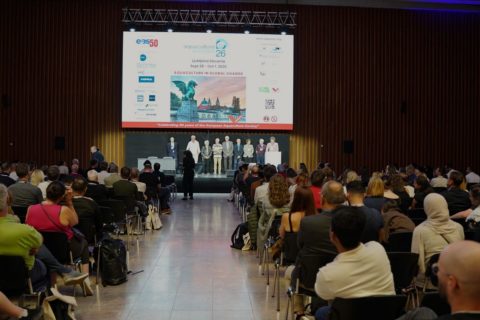
Ljubljana, Slovenia, 29 September 2026 | Alistair Lane identifies three milestone in the Society’s history: expanding its scope to encompass all aquaculture, creating its student group and adding an exhibition to the scientific conference