


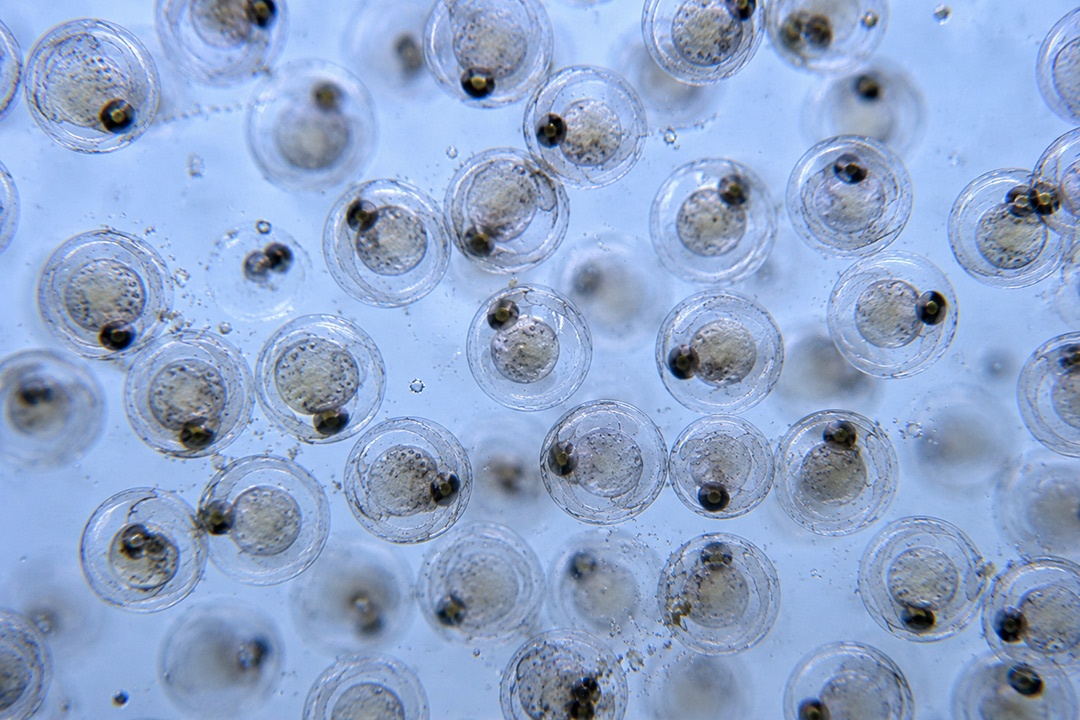
Aquaculture is usually measured in tonnes produced, growth rates, feed conversion or market prices. Yet before any grow out phase begins, there is a much less visible critical point: reproduction.
The hatchery is the starting point of the entire production chain. If broodstock do not mature properly, ovulate, release visible sperm or produce high-quality eggs predictability, there will not be enough juveniles. Without juveniles, there can be no reliable production planning, scaling or commercial stability.
In the wild, fish reproduce when they receive a precise combination of environmental and physiological signals, including temperature, photoperiod, salinity, water flow, social behaviour and habitat conditions.
In captivity, many of these signals are not reproduced with the same intensity or timing. The result may be incomplete maturation, irregular spawning, poor sperm quality or reproductive failure.
Controlled reproduction therefore remains one of the major bottlenecks in modern aquaculture. It is important even in established species, but becomes particularly critical in diversification programmes, high-value species and intensive systems that depend on highly precise production schedules.
The physiological basis lies in the hypothalamic-pituitary-gonadal axis, which regulates maturation, ovulation, spermiation and spawning.When environmental signals fail to activate this system correctly, hatcheries need to intervene.
This explains the use of hormonal induction tools such as GnRH analogues, hCG and sustained-release systems, which have made it possible to synchronise spawning, obtain eggs outside the natural season and improve juvenile availability.
These tools are not, however, a universal formula. Each species responds differently, and effectiveness depends on broodstock condition, timing, dose, temperature, stress and previous husbandry. A protocol that works for one species may fail in another.
The future, therefore, does not lie in using more hormones, but in using them more precisely. The trend is towards precision reproduction, in which environmental control, biomarkers, sensors, automation and behavioural data help determine when to intervene, at what dose and with which broodstock.
Advances in biodegradable implants, controlled-release systems, multi-omics, artificial intelligence and gene editing are opening up new possibilities. Many of these technologies still require commercial validation, lower costs and clearer regulatory frameworks. The immediate challenge for hatcheries is not adopting futuristic promises, but to improve the precision of existing protocols.
The productive impact can be substantial
A hatchery that controls reproduction more effectively reduces uncertainty, improves batch scheduling, limits early-stage losses and provides greater security for nursery and grow-out operations. In emerging species, this can mark the difference between experimental production and a scalable industry.
There is also a welfare and sustainability dimension. More precise protocols can reduce repeated handling, broodstock stress and the potential release of hormonal residues into effluents.
Reproduction will remain invisible to consumers, but not to producers. A large part of the aquaculture output that eventually reaches the market is decided at the hatchery stage.
Induced reproduction is not a universal recipe for making fish spawn, but a precision tool that only works when the biology of each species, broodstock condition and the hatchery environment are properly understood.

Latest news
-
ASC postpones mandatory transition to its new farm standard until May 2028
Global, 10 July 2026 | Certified farms will have an additional year to move away from species-specific standards as ASC reviews requirements that have raised practical implementation issues during early audits
-
Why reproduction remains aquaculture’s invisible bottleneck
Global, 10 July 2026 | Control of spawning, egg and sperm quality, and the regular availability of juveniles determine the productive viability of many aquaculture species
-
Stolt Sea Farm advances its largest expansion programme after stronger first-half results driven by sole and turbot prices
Spain / Portugal, 9 July 2026 | The company increased revenue by 25% and operating profit by 18% in the first half of 2026, supported by stronger market prices for turbot and sole while accelerating new investments in Spain and Portugal