
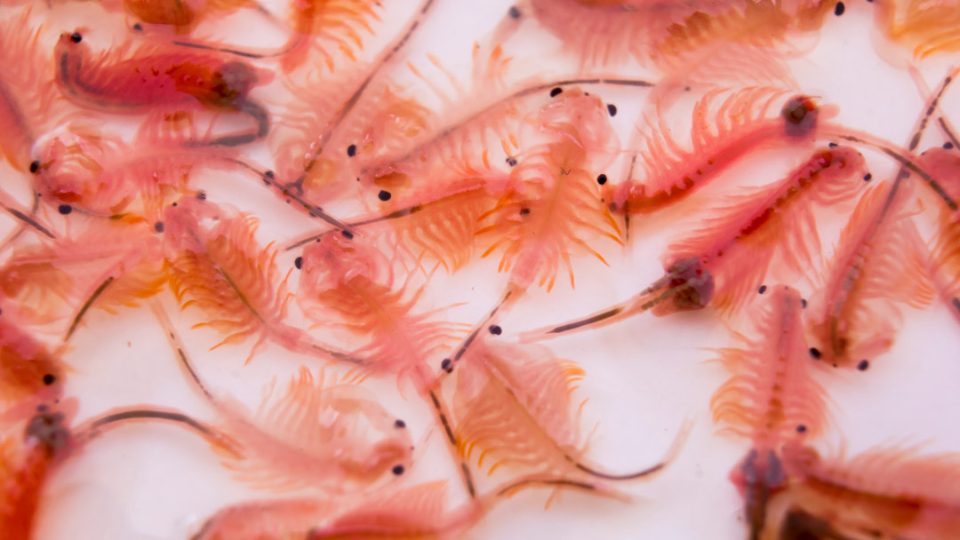
The expansion of aquaculture is increasing pressure on the global supply of Artemia, an essential live feed for larval production whose market is currently estimated at between US$350 million and US$400 million a year.
According to several reports prepared for the World Bank, hatcheries consume around 3,500 tonnes of cysts annually, but demand could exceed 5,000 tonnes by 2035, when the market value is projected to surpass US$500 million.
Meeting this growth would require and additional 1,000 to 1,500 tonnes, a volume comparable to the output of another major hypersaline lake.
The main risk lies in the origin of the product. More than 90% of traded cysts still come from wild populations exposed to environmental and production fluctuations. A particularly significant share is harvested from the Great Salt Lake in the United States, which in some years supplies more than 40% of the global market.
This concentration leaves hatcheries exposed to potential variations in availability, quality and price linked to salinity, water levels, climatic conditions and natural resources management.
Artemia continues to play a role that is difficult to replace completely in larval feeding. Its nauplii can be supplied live, enriched with specific nutrients and adapted to the requirements of different species and developmental stages.
Despite advances in microdiets and other live feeds, shrimp hatcheries and those producing many marine fish species continue to rely on it to achieve good growth and survival rates.
Security of supply therefore affects one of the most sensitive points in the aquaculture production chain.
The reports argue that this dependence should be reduced by scaling up controlled Artemia farming, which currently accounts for less than 10% of the cyst supply. One of the proposed options is production in solar saltworks and hypersaline ponds, using areas where high salinity limits the presence of predators.
This model does not require freshwater and could allow the same site to produce salt, cysts and Artemia biomass.
The proposal could also be relevant to Mediterranean countries with saltworks and established marine hatcheries industries. Spain, Italy, Greece, Croatia and Türkiye are identified as markets linked to marine fish hatcheries, although the reports neither quantify the specific potential of their saltworks nor establish the economic viability of large-scale production in these countries.
Any implementation would require an assessment of local conditions, cyst yield, investment needs and possible environmental constraints.
The challenge is not simply to increase production, but to ensure a stable supply of traceable cysts with high hatching performance.
As aquaculture demand grows, continuing to rely almost entirely on wild populations could turn Artemia into a bottleneck for hatcheries. Scaling up controlled production would diversify sources, reduce exposure to fluctuations in a small number of lakes and strengthen production security during the earliest stages of aquaculture.

Related

Latest In-depth
-
Clams more resistant to heat and Perkinsus: research paves the way for selective breeding
Padua, Italy, 16/10/2026 | University of Padua researchers explain to misPeces the findings presented at Aquaculture Europe 2026 and the steps needed to transfer them to hatcheries. Initial applications could emerge within the next two or three years, although the relationship between resistance, growth and other production traits still need to be assessed