
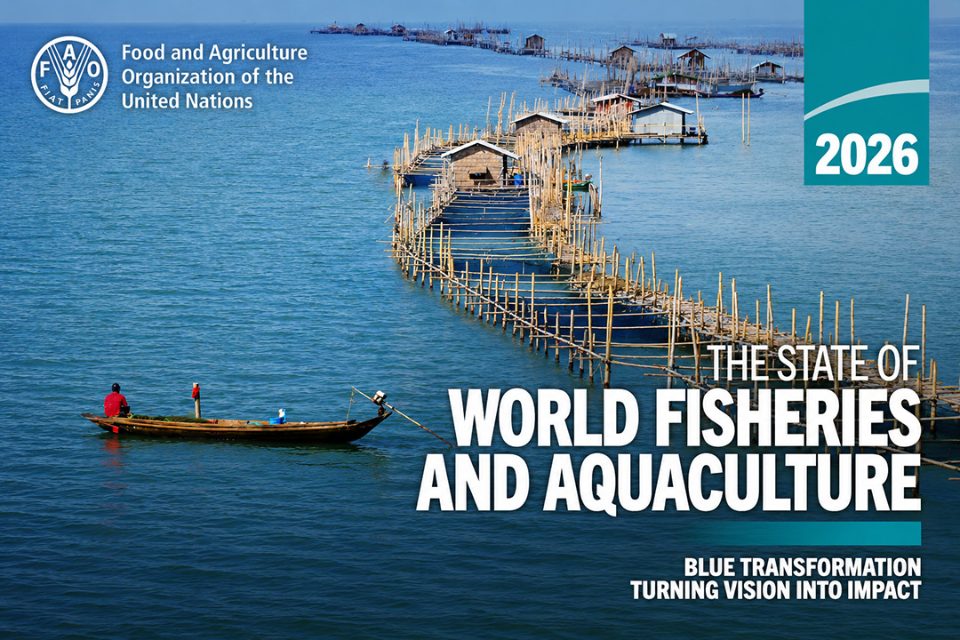
The FAO has confirmed in the summary version of The State of World Fisheries and Aquaculture 2026 (SOFIA 2026) one of the figures that misPeces had already highlighted following a presentation by Manuel Barange — Director of the Fisheries and Aquaculture Division at FAO — during Spain’s XX National Aquaculture Congress: global aquaculture production of aquatic animals has surpassed 100 million tonnes for the first time in history.
According to the report, aquaculture production of aquatic animals reached 102.7 million tonnes in 2024, a record high that places aquaculture ahead of capture fisheries as the world’s leading source of aquatic animal production. Including seaweeds, total aquaculture production reached 142 million tonnes.
Global aquaculture has crossed the 100-million-tonne threshold for aquatic animals for the first time in history.
The figure confirms a structural transformation that has been unfolding over recent decades. While capture fisheries have remained relatively stable since the late 1980s at around 90 million tonnes per year, additional growth in the global aquatic food supply is increasingly being driven by aquaculture.
In 2024, farmed aquatic animals accounted 53% of total global aquatic animal production.
The publication of SOFIA 2026 comes only weeks after Manuel Barange warned in Vigo about the growing divergence between global sector trends and the European situation. While Asia, Africa, and Latin America continue to expand their production capacity, Europe remains characterised by stagnation and, in some strategic segments, decline.
Although the report does not provide a detailed assessment of European self-sufficiency, it highlights the increasing importance of international aquatic food trade. In 2024, global trade in aquatic products reached a value of USD 186 billion, with Europe remaining the world’s largest importing region, accounting for 41% of the total value of global imports.
The European Union was also the largest single market for aquatic product purchases, with acquisitions valued at USD 63 billion.
While global aquaculture continues to expand, Europe risks becoming increasingly dependent on production developed in other regions.
FAO notes that aquaculture growth remains heavily concentrated in Asia, which accounts for approximately 89% of global farmed aquatic animal production. China maintains a dominant position with 56% of global output, followed by India, Indonesia, Viet Nam and Bangladesh. Together, these five countries represent 82% of total global aquaculture production.
Another important aspect of the sector’s evolution is the predominance of inland aquaculture. Of the 102.7 million tonnes of aquatic animals produced through aquaculture in 2024, 64.3 million tonnes came from inland freshwater systems, equivalent to 63% of total production. Marine and coastal aquaculture contributed a further 38.3 million tonnes.
This distribution highlights that much of global aquaculture growth is being driven by freshwater species farmed in Asia, while regions such as the Mediterranean remain far more specialised in marine species production, including gilthead seabream, European seabass, and meagre.
FAO projections indicate that this trend will continue over the next decade. The organisation estimates that global aquatic animal production will reach 124 million tonnes by 2034, compared with 195 million tonnes in 2024.
Most of this growth is expected to come from aquaculture, whose output is expected to come from aquaculture, whose out could rise to 119 million tonnes, while capture fisheries are projected to increase more modestly to 95 million tonnes.
The organisation cautions, however, that production growth alone will not guarantee improvements in food security. Sustaining the sector’s expansion will require further progress in efficiency, technological innovation, access to finance, knowledge transfer and regulatory frameworks capable of supporting sustainable investment.
In this context, Africa stands out as one of the world’s most underutilised growth opportunities. FAO notes that the continent has the lowest per capita availability of aquatic animal foods globally, despite its strong nutritional dependence on these products. Expanding aquaculture will be essential to prevent population growth from further reducing access to aquatic protein.
As the world accelerates aquaculture development, Europe is becoming progressively more dependent on external production.
Beyond the production records, the underlying message of SOFIA 2026 echoes the one delivered by Manuel Barange when he argued that aquaculture can no longer be viewed merely as a complementary activity to fisheries. It is increasingly becoming strategic infrastructure for ensuring food security, employment and the resilience of food systems in the decades ahead.
The key question for Europe is whether it will be able to participate actively in this expansion or whether it will continue increasing its dependence on production developed elsewhere in the world.

Related


Latest In-depth
-
Clams more resistant to heat and Perkinsus: research paves the way for selective breeding
Padua, Italy, 16/10/2026 | University of Padua researchers explain to misPeces the findings presented at Aquaculture Europe 2026 and the steps needed to transfer them to hatcheries. Initial applications could emerge within the next two or three years, although the relationship between resistance, growth and other production traits still need to be assessed