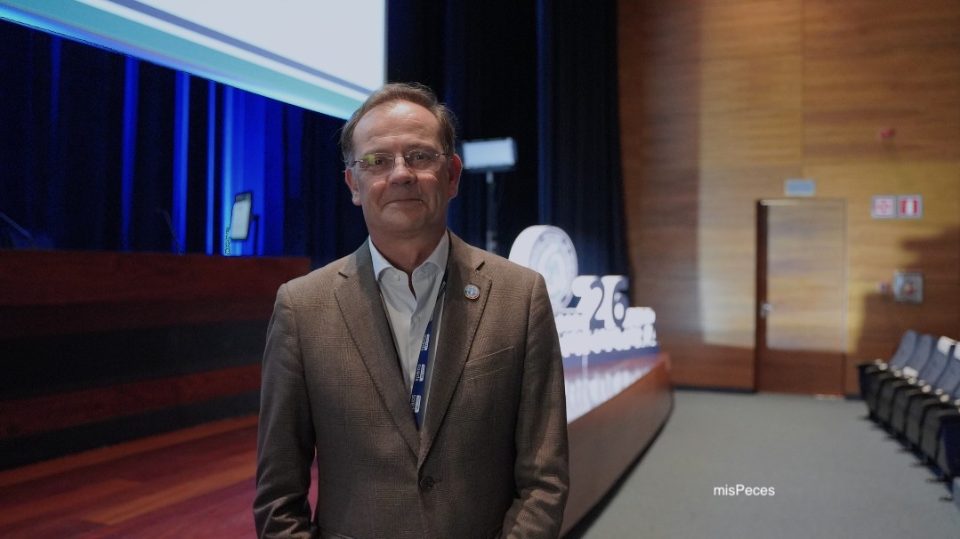
 Manuel Barange (FAO) | misPeces
Global aquaculture production has surpassed 100 million tonnes of aquatic animal production for the first time in history, but Europe is moving in the opposite direction.
While Asia, Africa and Latin America continue accelerating the development of aquaculture as strategic food infrastructure, the European Union is steadily losing production capacity, increasing its dependence on imports and reducing its weight within the global aquatic protein system.
That was one of the main messages delivered by Manuel Barange, Director of Fisheries and Aquaculture at FAO, during the opening session of Spain’s XX National Aquaculture Congress, held in Vigo.
Far from a traditional institutional speech, Barange’s intervention delivered a clear warning: aquaculture is no longer simply part of the fisheries sector; it is becoming an issue of food security, strategic autonomy and geopolitical competitiveness.
According to Barange, in an advance preview of the upcoming SOFIA 2026 report, FAO data show that global aquatic animal aquaculture production reached 103 million tonnes in 2024, the highest volume ever recorded. Around 60% of this production comes from freshwater aquaculture, with the remainder corresponding to marine farming.
Global aquaculture production surpasses 100 million tonnes of aquatic animal production for the first time in history.
Global growth continues to be driven mainly by Asia, where technological innovation and production intensification are still accelerating, while Africa is emerging as one of the regions with the greatest long-term expansion potential.
FAO estimates that 85% of additional aquatic food production growth over the next decade will come from aquaculture. The reason is structural: global consumption of aquatic protein continues to grow faster than the world population, while capture fisheries have remained stable for decades at around 90 million tonnes annually.
Within this global expansion scenario, Europe stands out as an exception.
Europe is losing production capacity while the rest of the world accelerates aquaculture as a strategic food system.
Manuel Barange acknowledged that EU aquaculture production has been declining by nearly 1% annually over the last two decades, while European capture fisheries are shrinking by around 2.3% per year.
The direct consequence is growing external dependence. According to Barange, while the European Union produced around 70% of the aquatic products it consumed during the 1990s, that figure has now fallen below 50%.
The sector’s trade balance also records a deficit of nearly USD 23 billion annually. Global per capita consumption of aquatic foods has already reached 21.3 kilograms per person per year and continues to rise.
Over the last 25 years, global aquaculture production has grown at an average annual rate of around 5%, making it one of the fastest-growing food production sectors.
For FAO, the problem is not only productive, but strategic. Maintaining current levels of fish consumption until 2050 will require a significant increase in global aquaculture production simply to compensate for demographic growth.
Africa alone will need to increase its production by 75% just to maintain current per capita consumption, which remains well below the global average.
The EU now produces less than half of the fish it consumes.
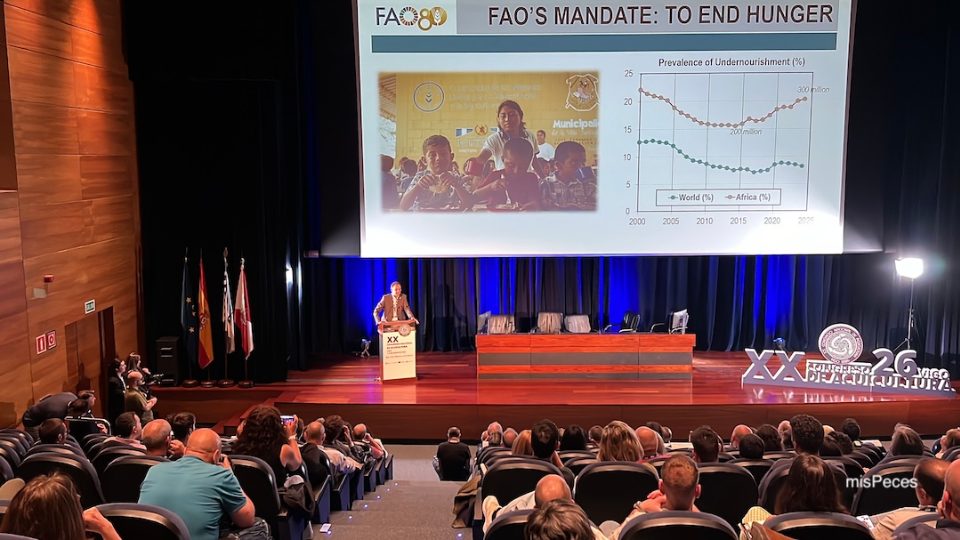 During the intervention | misPeces
Barange defended the so-called “Blue Transformation” promoted by FAO as a strategy aimed precisely at accelerating sustainable aquaculture expansion capable of delivering high-value protein with a lower environmental footprint relative to other livestock systems.
FAO projects that global aquatic product production could reach 134 million tonnes by 2034, reinforcing the idea that future growth in seafood supply will depend increasingly on aquaculture.
By mid-century, aquaculture production could reach between 159 and 255 million tonnes depending on the pace of technological, regulatory and financial development. Under FAO’s "Blue Transformation" scenario, global aquatic food productioncould increase by 25.5% by 2050.
However, one of the strongest parts of the intervention came when Barange addressed the barriers slowing growth in Europe and North America.
From his perspective, the aquaculture sector has lost the ability to define its own public and environmental narrative.
“Environmental and sustainability narratives are not being defined by the sector itself.”
“Environmental and sustainability narratives are not being defined by the sector itself.”
The FAO official also implicitly questioned the imbalance of European regulatory frameworks and the sector’s difficulty competing politically with industries carrying greater economic weight.
In his view, aquaculture needs “a seat at the table” when decisions are made regarding spatial planning, environmental regulation and industrial development.
The underlying message was clear: while much of the world increasingly sees aquaculture as a strategic tool to strengthen food security, nutrition and future resilience, Europe continues facing a scenario of declining production, growing import dependence and difficulties transforming aquaculture projects into real industrial capacity.
Aquaculture is no longer presented merely as a complementary fisheries activity. For FAO, it is increasingly becoming part of the strategic global infrastructure that will determine how the world’s population is fed in the coming decades.
Key figures from Manuel Barange’s intervention
| Indicator | Key figure | Strategic reading |
|---|---|---|
| Global aquaculture production | 103 million tonnes in 2024 | Aquaculture enters a new scale as a global food system. |
| Freshwater aquaculture | Around 60% of global production | Freshwater systems remain central to global aquaculture growth. |
| Global per capita consumption | 21.3 kg per person per year | Demand for aquatic foods continues to grow worldwide. |
| Long-term aquaculture growth | Around 5% annual growth over the last 25 years | Aquaculture is one of the fastest-growing food production systems. |
| Future growth | 85% of additional growth will come from aquaculture | Capture fisheries are stable; food expansion will come from farming. |
| 2034 projection | 134 million tonnes of aquatic products globally | Aquaculture is expected to drive the next stage of seafood supply growth. |
| EU aquaculture production | Nearly 1% annual decline over the last two decades | Europe is losing industrial capacity in a strategic sector. |
| EU capture fisheries | Around 2.3% annual decline | Europe’s loss affects the whole aquatic food supply. |
| EU self-sufficiency | Less than 50% of consumed fish is produced by EU operators | Import dependence becomes a food sovereignty issue. |
| EU trade deficit | Almost USD 23 billion annually | Production decline has a direct economic impact. |
| Africa’s challenge | 75% production increase needed to maintain current per capita consumption | Aquaculture will be key to future access to aquatic protein. |
| 2050 outlook | 25.5% increase in per capita aquatic food consumption | Aquaculture expansion will be decisive for future food security. |
Related

Latest news
-
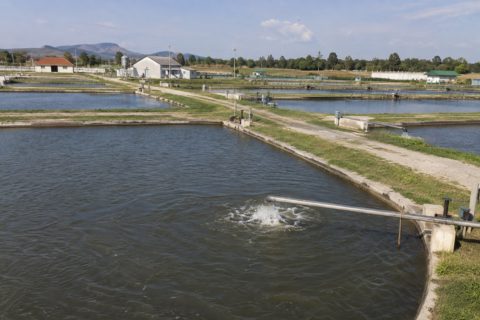
FEAP calls for pond farms to be compensated for the ecosystem services they provide
Brussels, 16 September 2026 | The European organisation is calling for these farms to be integrated into water management, drought resilience and wetland restoration policies
-
Global fishmeal production falls 49%, keeping pressure on aquafeed supplies
London, 15 September 2026 | Lower output from Peru and Chile has also weighed on fish oil production, which fell by 30%, while the industry hopes Asian fishing seasons in the final quarter will offset part of the shortfall
-
Nordic Kingfish increases yellowtail production but loses NOK 471 million after asset write-down
Norway, 16 September 2026 | The Norwegian facility harvested 584 tonnes in 2025 and increased revenue to NOK 75 million