


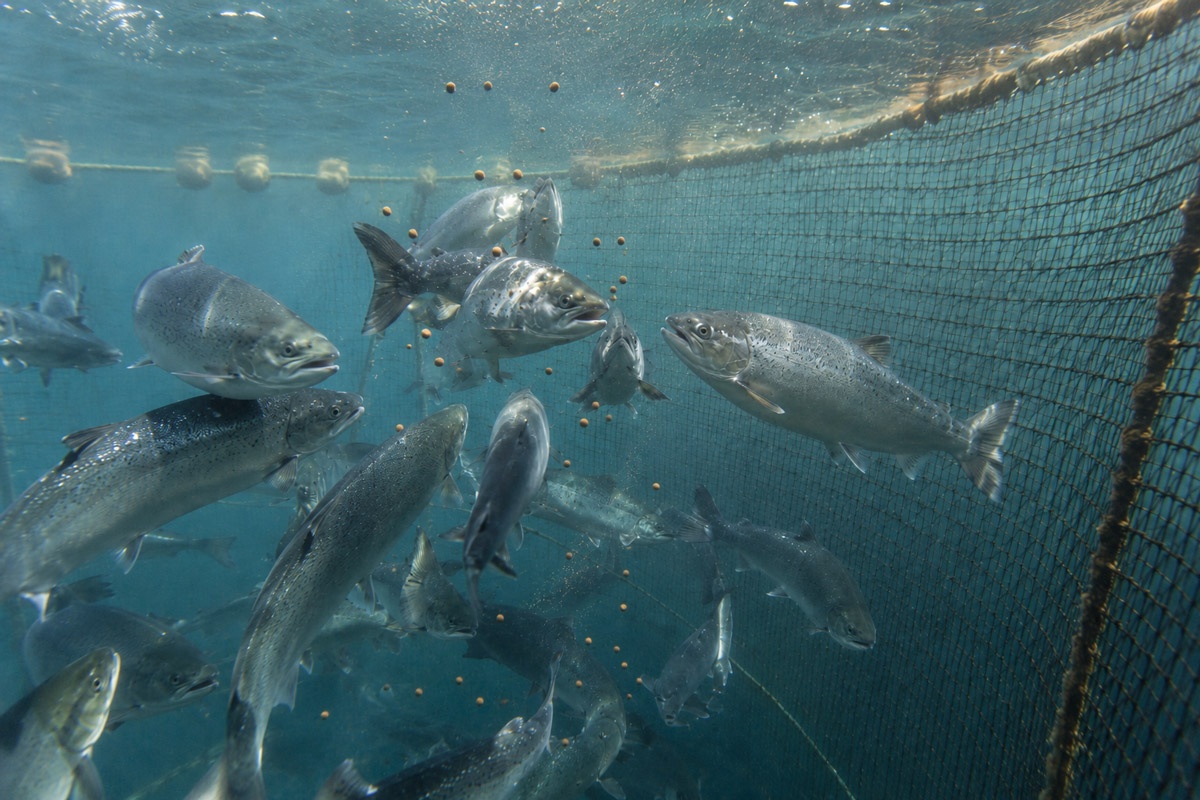
Increasing the concentration of the omega-3 fatty acids EPA and DHA in salmon feed could help improve farm productivity and reduce variability in production outcomes. A commercial-scale study covering more than 430 million Atlantic salmon links EPA+DHA levels above 9% of total fatty acids with lower mortality, improved feed conversion and a higher proportion of superior-grade fish.
The study analysed 556 salmon generations produced in sea cages across several Norwegian farming regions between 2013 and 2023. The researchers reconstructed the production history of the fish and adjusted comparisons for variables including smolt size, time at sea, feeding rates, environmental exposure, sea lice treatments, vaccination, disease incidence and previous mortality.
Compared with populations receiving less than 7% EPA+DHA, those fed levels above 9% recorded 8% lower mortality, with the mortality rate falling from 13.3% to 12.2%. Economic feed conversion ratio, or eFCR, improved by 13%, from 1.26 to 1.10, while the proportion of fish classified in the highest commercial grade increased by 2%. The prevalence of melanin spots and blood spots in fillets was also reduced by 7% and 40%, respectively.
Beyond the average results, the study found that production outcomes became more predictable. Variability between populations declined by 50% for mortality, 27% for eFCR and 29% for harvest quality. This suggests that maintaining higher EPA and DHA concentrations could become a nutritional risk-management strategy under the different environmental, health and operational conditions encountered across farms and production cycles.
The authors also modelled a scenario in which EPA+DHA was increased from 6% to 10% using algal oil. Although this change slightly increased the carbon footprint of the feed itself, the assumed improvements in survival and feed conversion reduced the carbon footprint per kilogramme of harvested salmon by 17% and dependency on oil from forage fisheries by 15%. The model also produced a positive return on investment, although this depended on omega-3 prices, feed costs and the market value of the fish.
The findings should be interpreted cautiously because they come from an observational analysis and do not prove that EPA and DHA levels were solely responsible for the improvements. The dataset did not consistently account for other nutritional components of the feeds and was limited to Norwegian sea-cage production. The study was fully funded by algal-oil producer Veramaris, which was involved in its design, analysis, interpretation and preparation.
Reference: Carr, I. et al. (2026). “Higher dietary EPA & DHA levels improve commercial salmon farming productivity, predictability and sustainability”. Frontiers in Marine Science, 13, 1924168. DOI: 10.3389/fmars.2026.1924168

Latest news
-

Cormorants leave European freshwater aquaculture bearing losses and protection costs with little compensation
Roma, Italy, 25 August 2026 | An inventory by FAO, EIFAAC, EAA and FEAP puts annual losses reported by fish farms at more than EUR 138 million and extrapolates the European total to around EUR 250 million
-
Test strip brings furunculosis diagnosis closer to trout farms
China, 25 August 2026 | The method identifies Aeromonas salmonicida in around one hour without a thermal cycler, but DNA extraction and limited clinical validation still prevent routine field use
-
Higher dietary EPA and DHA levels linked to lower mortality and improved feed conversion in salmon
Norway, 26 August 2026 | An analysis of more than 430 million fish associates levels above 9% of total fatty acids with better and more predictable production outcomes, although the observational study cannot demonstrate causality