


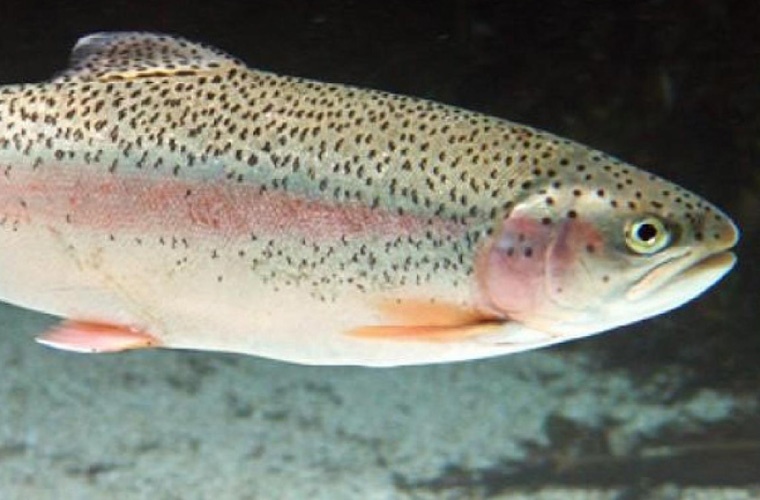
A team of Chinese researchers has developed a method capable of detecting Aeromonas salmonicida, the bacterium responsible for furunculosis, in around one hour using a visually readable test strip. The technology could eventually bring diagnosis closer to trout farms, shortening the time required to confirm the pathogen’s presence and initiate control measures.
The system combines recombinase polymerase amplification — a technique that amplifies DNA at a constant temperature — with CRISPR/Cas12a, which recognises a conserved region of the bacterium’s fstA gene. Results can be read on a lateral-flow strip without a thermal cycler, complex laboratory equipment or highly specialised personnel.
In sensitivity tests, the test-strip version detected as few as 100 DNA copies per reaction, while the fluorescent format reached one copy per reaction. The researchers also observed no cross-reactivity with eight other bacterial pathogens commonly found in aquaculture, including Aeromonas hydrophila, Yersinia ruckeri, Flavobacterium psychrophilum and several Vibrio species.
The platform was also evaluated using experimental samples and tissues from five rainbow trout suspected of being infected. Four of the five fish tested positive with both the test strip and the CRISPR/Cas12a system, matching the results subsequently obtained by real-time PCR. This initial agreement supports the platform’s potential, although the small number of fish is insufficient to validate its diagnostic accuracy under commercial farming conditions.
For farms, the main potential advantage would be a shorter interval between the first warning signs and confirmation of infection. Furunculosis can cause lesions, ulcers and high mortality in salmonids, meaning that earlier detection could support the isolation of affected stocks, stronger biosecurity and faster veterinary decisions before an outbreak spreads.
However, the method is not yet ready for routine farm use. The authors acknowledge that DNA extraction remains cumbersome and limits its field application, while specificity was assessed against only the two predominant subspecies of A. salmonicida. Sample preparation must therefore be simplified and validation expanded to include more fish, subspecies and production conditions before this proof of concept can become a commercial diagnostic kit.
Reference: Tan, F. et al. (2026). “Development of a rapid and visual detection platform for Aeromonas salmonicida based on the RPA-CRISPR/Cas12a system”. Aquaculture, 623, 744116. DOI: 10.1016/j.aquaculture.2026.744116

Latest news
-
Cormorants leave European freshwater aquaculture bearing losses and protection costs with little compensation
Roma, Italy, 25 August 2026 | An inventory by FAO, EIFAAC, EAA and FEAP puts annual losses reported by fish farms at more than EUR 138 million and extrapolates the European total to around EUR 250 million
-
Test strip brings furunculosis diagnosis closer to trout farms
China, 25 August 2026 | The method identifies Aeromonas salmonicida in around one hour without a thermal cycler, but DNA extraction and limited clinical validation still prevent routine field use
-
Less anchovy in Peru: what options does aquaculture have now?
Global, 24/08/2026 | The clousure of Peru’s first season with barely a quarter of the quota caught is not simply a fishing statistic: it is a warning sign for the entire aquaculture chain, which is seeing access narrow to two of its hardest-to-replace inputs