

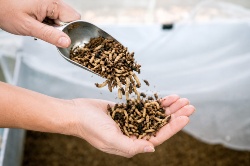
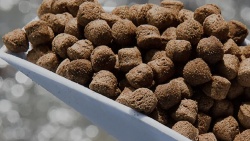
Science is beginning to confirm that insects can play a relevant role in aquaculture nutrition thanks to their protein and lipid content, provided they are produced from suitable substrates and with a controlled nutritional composition. Among these fractions, insect oils are attracting particular interest as alternatives to certain terrestrial animal fats currently used in feed formulation.
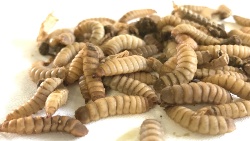
One example is black soldier fly larvae oil, which in experimental trials with juvenile marine fish has shown that it can replace poultry fat without compromising performance. Although it is not, by itself, a significant source of EPA and DHA, it can serve as an energy source and, in some treatments, has even been associated with improvements in growth and feed conversion.
Caution is needed when these results are taken beyond the experimental setting. Responses can vary between species and inclusion levels, and a substitution that works for a few weeks in juveniles does not guarantee the same outcome during grow-out or across a full production cycle. Demostrating nutritional equivalence under controlled conditions also does not mean that an ingredient is automatically competitive or reproductible at commercial scale.
There is also a single standard profile for black soldier fly oil. Its composition depends, among other factors, on the substrate used to rear the larvae. Marine raw materials or microalgae can increase its omega-3 content, including EPA and DHA, but this raises another question: how much does it cost to achieve that profile, and what is the advantage of using the insect as an intermediary for nutrients that originally come from other sources?
The key issue therefore shifts from whether insect oil can technically replace another fat to when it makes economic sense to do so. In feed manufacturing, prices, availability, batch-to-batch consistency and security of supply are as important as the biological response of the fish.
An improvement in feed conversion could offset a higher inclusion cost, but this can only be demonstrated by combining biological performance with real production costs and volumes representative of industrial feed manufacturing.
Before broad adoption can be considered, further trials will be needed with larger fish, longer production periods and real farm conditions, alongside assessment of ingredient stability and final product quality.
There is also one test beyond the feed mill and the farm: how consumers perceive farmed fish being fed ingredients derived from insects. Nutritional viability is beginning to build a stronger evidence base; proving economic, productive and commercial value is the next step.

Related

Latest In-depth
-
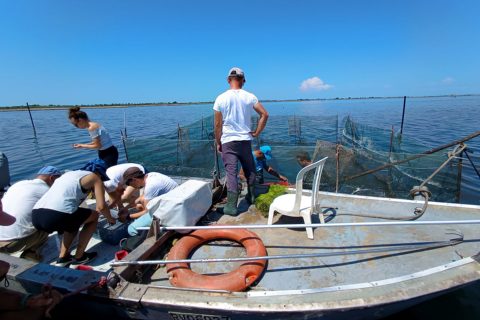
Clams more resistant to heat and Perkinsus: research paves the way for selective breeding
Padua, Italy, 16/10/2026 | University of Padua researchers explain to misPeces the findings presented at Aquaculture Europe 2026 and the steps needed to transfer them to hatcheries. Initial applications could emerge within the next two or three years, although the relationship between resistance, growth and other production traits still need to be assessed